Thursday, 26 April 2018

Rampage movie review

Here's what you need to know; life's about to take a turn for the fantastical for Primatologist Davis Okoye when one of his apes begins to grow at an impossible rate. But George isn't alone, as a dangerous contaminant has been unintentionally released into the world, turning the creatures it infects into nightmarish monsters, and as the threat grows, literally, Davis realises how out of their league the military is against the threat, and that he's George's only chance of survival in the coming apocalypse.
This film as an anomaly to me; clearly Hollywood still thinks it can make a good movie based on a video game, and I reckon that they can, I'm just waiting for them to make one that doesn't fall somewhere between decent and dreadful. The anomalous part is that it's a movie based on Rampage, a series that has been dead for twelve years, I suppose Halo, Metal Gear Solid, Watch Dogs, Uncharted, Dead Space or any other major game release in the last decade that might be at least a shred better suited to the big screen was off the table, this film clearly seems to come more from the Battleship school of thought. Wow, haven't even started the review yet and I already sound like I hated the film, so let's slow down, and look at this film honestly.

Rampage's opening is not what I was expecting, but it opens up an idea that I think the film could have done more with. The opening is basically the last 20 minutes or so of last year's Life, you know, that film that scared me and my friends utterly witless. For this and another scene in the first act, it almost looked as though they were going for a horror vibe with the film, first with a space station being destroyed by a mutated lab rat, then with a squad of soldiers being wiped out in a forest by Ralph (the wolf.) These two scenes aren't remarkable when viewed as horror, they rely a bit too much on the good old trick of loud audio cues every time something happens, but this isn't a horror, so that's me projecting onto the film, rather than looking at what it does have. Right out of the gate, the film presents a pair of likable characters in Davis and George; Dwayne Johnson is basically playing Dwayne Johnson, and that's neither surprising, nor a bad thing from the right point of view, but the friendship he has with George is surprisingly well done, or better done than the relationship with Chris Pratt and his raptors at least. George is no Caesar, but the scenes in the film where he isn't out of his mind on the rampage virus present a very funny, very vulgar guy with a believable and kind of sweet friendship with Davis. The obligatory backstory scene that provides George's origins is expectedly ham-fisted, but it does at least explain how a Primatologist knows how to kill things, which obviously becomes useful in the film's finale. Naomi Harris' character is easily the least memorable lead in the film, as her job seems purely to be delivering exposition, which always makes for a compelling character. And then there's Negan, and I don't mean that as a Joke, Jeffrey Dean Morgan's character in this film is Negan, or rather what would happen if Negan was a cowboy, which also isn't a joke. He was probably my favourite character in the film, but I can imagine that if you hated him in The Walking Dead, you'll be less fond of Jeffrey Dean Morgan in this film than I. So far then, that's a serviceable line up, two likable actors falling comfortably into their respective typecasts, and Naomi Harris just kind of being there, but for me film really took a turn for the worse with its villain; Wyden, but that's a point that needs further expansion.

Easily the biggest two issues that bog this movie down are a plot that makes no sense, and an inconsistent and wonky tone. This is a monster movie, in the same vein as films like King Kong or Godzilla, incidentally two films from which the Rampage video games take influence. The issue however is that this film's plot is really dumb, complete with a sinister organisation doing illegal experiments, a hyper corporate, morally empty CEO villain, and an action hero turned zoologist becoming man's last hope against giant monsters. That villain really does hurt the film in the long run, as even by this film's own standards, she's absurd. She so blatantly villainous, in fact stupidly so, being the CEO of a major company, and also thinking that putting millions of lives at risk by field testing your new bioweapon is a good idea. She even comes complete with a dim-witted minion, and it derails the film every time it cuts to her. The film establishes a timeline of us inventing genetic editing, which can, from the right point of view, explain away a few of this film's absurdities, like how these monsters grew so big, so fast, and how Ralph and Lizzie (the crocodile) look and act nothing like their uninfected, real world counterparts. But then there's things like the zoologist who knows how to operate an Attack Helicopter's weapons and literally can't die, not even being slowed down with a bullet in him, or the super villain whose plan is so stupid that the only thing missing is a volcano hideout. The problem this presents is tone; the film is very much like Pacific Rim: Uprising in the sense that it foregoes a compelling story for mindless action, but like that film, it doesn't commit to style or substance, the story is executed sloppily and nonsensically, and it's not as cool as it wants to be in the action. I said before that this film is in the same vein as Godzilla and King Kong, but absent is the substance of Godzilla, this film has no grand metaphors for contemporary societal fears or ominous, Lovecraftian undertones like the 1954 and 2014 films, nor does it have the adventurousness of Kong, and if was going for style, again, Pacific Rim could run rings around it. This film lacks the flash of a film like Pacific Rim, and without a compelling story, the film's biggest blessings become its typecast mains, and while they're fine, the film ultimately comes across as forgettable.

This is an action film and a monster film before it's anything else, and as already stated, as a monster film, it's unremarkable, but what about an action film? There are many films that are comparable to what this film strives for in its action, films like Transformers, Roland Emmerich's Godzilla, and Battleship, films with sloppy writing, and-or acting, and-or directing, but that succeed in the very imprecise art of being mindless entertainment. Rampage's finale where the three monsters are tearing up Chicago is entertaining, even I won't deny that; seeing Ralph and George ripping through the streets and cleaning up infantry is dumb and enjoyable, and when Lizzie emerges from the river, it was all very reminiscent, and it was cool. It is, not all that different to Michael Bay's Transformers, ridiculous, with Dwayne Johnson out manoeuvring the monsters and hurting them with a little grenade launcher, after tanks and .50 Cals and a 30mm cannon did nothing, also bear in mind that he is doing this after being shot in the torso, because Dwayne Johnson is apparently a literal god. It's the kind of action that falls apart when you think about it, even just a little bit, but will get the job done if all you want is big, loud, visually stimulating action for the sake of action. Rampage's titular rampage is without a doubt the high point of the film, never mind the lack of style, or the minor grievance that the effects aren't always up to snuff, most notably the green screen, which is occasionally horrible. Something I do like in the film's finale however was the brutality of the fighting, Lizzie and Ralph and George turning on each other and literally ripping pieces off one another is more like it, at least for me, me who gets a bit of a tickle every time he watches Godzilla breathing fire down the MUTO's neck. And though getting impaled through the face or being mutilated in a death roll isn't quite as brutal, it's still pretty sweet. Also pretty sweet is that this film really stretches it's 12 rating, with people being eaten and crushed by debris, a vulgar ape, and literal piles of bloody dead bodies, it was quite amusingly surprising to see a severed hand on the big screen given how many families were in the cinema for the screening, but of course I'd think that, I'm just a sadist I suppose.

Hell of a day, huh?
Rampage is what it is; a loud, big, violent spectacle build for the big screen, a film that's enjoyable, so long as you don't think about it too much. If you did that, you'd find a film with likable, unsurprising characters, but a story that struggles to make sense, made even worse by a villain that represents a massive tonal inconsistency in the film. The film is really, really dumb, but that is at least partially absolved in the finale, where I'd be lying if I said I wasn't having fun, even though it's not the best monster or action movie out there, not by a long shot. Rampage is unremarkable and forgettable, but serves its purpose of being entertaining, if you watch Rampage, you'll probably get exactly what you think you'll get, I had fun watching it, and I'd say it's worth a watch.

Monday, 23 April 2018

We gotta get out of this place

It's 2018, more specifically it's the tail end of April, and my gal hasn't seen any action in a few months, honestly, the last time I went out with my camera was when my piss take of a country was buried under a few inches of snow, which is enough to entomb a nation here, because we's pussies. All I took photos of was my Lego Icebreaker too, which sounded like a great idea, but they were crap, seriously, they were dreadful. Fortunately it seems to have gone from winter to summer in just a few weeks, having gone from blizzards to clear skies and blistering heat, and I really don't mind. Though my shoes probably did, as I returned to what was left of the pit after its demolition, and found a river of mud about a foot deep that was completely invisible from the surface, which had dried up in the heat, to say I was surprised when the ground ate one of my feet would be an understatement. But oh well, they're clean now, and I got some bangers, including a lovely portrait photo of Mow Cop, and a couple dozen sunset shots that look like the poster for Apocalypse Now, one of which is now my banner, as you can see. I also went to my local wood, less bangers that time, save for a lovely photo of a pylon set against the sunset, what can I say, I like sunsets, and I'm actually decent at photographing them, they make good photos.

Peter Rabbit movie review

Here's what you need to know; after years of trying to fly under the radar of Mr. McGregor and numerous raids on his garden, Peter Rabbit and his family think they've finally won, until a younger, leaner, and far more dangerous McGregor moves in and makes it his mission to end Peter and his family's raids for good. But while Peter and McGregor wage a new, more vicious war for the garden, Peter and his family learn that there's more in this fight for Peter than he's willing to admit.
Every once in a while, a film comes along that I have absolutely no intention of watching, a film that repulses me for some reason or another, a reason that makes me recoil at the very prospect of watching it. Yet despite the alarm bells going off in my head, I watch them, and usually the results are messy. The fact that this film is from Sony Animation and stars James Corden was throwing up all sorts of red flags from the minute I knew of this film's existence, because like all who saw it, I still remember The Emoji Movie, and I still remember the pain. What also worried me was the fear that this was simply a Paddington ripoff, a prospect that makes me, from my position of immense bias, naturally, though perhaps unjustifiably hostile. Well, yesterday me and two friends sat in an empty cinema and watched Peter Rabbit, and I must ask myself the question; was I right, or will I have to eat crow and admit to liking a film that I wanted to hate, so no more delays, it's question time.

Peter Rabbit, in all honesty, caught me off guard a bit in its opening scene, not in the sense that it was extraordinary in any way, but more in the sense that I realised that it wasn't the film I was expecting. The film opened with a gag that I actually found funny, a gag that was considerably smarter than I was expecting, which I guess says more about my expectations than it does the film. The opening does what it needs to; it introduces Peter Rabbit and his family, Mr. McGregor and Bea, played by another one of my celebrity crushes, Rose Byrne, and provides a bit of backstory on the Rabbits and McGregor's mutual hatred, in a manner very meta and clearly attempting to be heart-felt, which it mostly pulls off. Then the plot kicks in following the early and surprisingly sudden demise of Mr. McGregor, and the introduction of McGregor 2.0, a control freak from London played by General Hux. Here is one of the ways that Peter Rabbit surprised me; it's story, which went to places I didn't think it would, and to depths that I, in all honesty, didn't think possible for a film starring James Corden. The first half of the film is what I thought it would be pretty much; Peter Rabbit and McGregor trying to kill each other, all while a spine destroyingly soppy romance develops between McGregor and Bea, which only intensifies Peter's resentment for McGregor. Even during this half of the film however, I found that I was actually enjoying myself, the film's jokes were more hit than miss, and some of them were remarkably funny, most notable in this regard is the film's handful of meta jokes, which I really wasn't expecting, but even the recurring jokes, which are much harder to pull off, were making me chuckle. Granted, one of my favourite recurring jokes in the film is a spin on a strikingly similar joke from Paddington and Paddington 2, that being the Calypso band that makes numerous appearances and provides diegetic music, only this time it's a group of birds that always get interrupted before they can finish their song, it's smart, it's meta, and I found it really funny. The film is far more self-referential and self-deprecating than I was expecting, and, like Paddington, pokes fun at itself and the conventions of its genre, sure it's not exactly original, but it works, somehow. Remarkably, the biggest issue I have with the film's humour is that the film doesn't really establish any sort of rules; for instance, later in the film, when Peter and McGregor have a conversation, McGregor questions whether or not it's in his head, meanwhile earlier in that very scene a little girl acknowledged that the rabbits could talk, meanwhile again Bea seems to never acknowledge that they can talk, even though they talk around her all the time, even insisting at one point that they're just rabbits, even though they're all wearing clothes, though you could very easily argue that I'm just nitpicking there, the point is I thought this film would be about as funny as a funeral, when in reality, I was laughing quite a bit.

It's in the second half of Peter Rabbit however that I had to throw everything I expected about this film out of the window. The latter half of the film, as well as carrying on the comedy, tries to hit the feels, as Peter Rabbit, in a move unprecedented for a Sony film starring James Corden, does some self-reflection, and decides to try and right his wrongs. This marks a substantial change in the film's tone, and one that would very easily collapse if the characters weren't good, so I guess that needs addressing. Peter Rabbit and his crew were not annoying, to my everlasting surprise, James Corden in the lead role somehow didn't make me want to drive pencils into my ear canals, in fact I warmed to Peter over the course of the film, I don't know how accurate to the source material his character is, as like Paddington before it, I know pretty much nothing about said source material, but I liked Peter Rabbit in this film (did a lot of hesitating before writing that.) Daisy Ridley also has a voice role in this film, so that's another crush of mine in this film, and like the rest of the rabbits, I didn't find her annoying. There was a rivalry between three of them, the triplets, that I thought was cute, and for some reason Benjamin was really funny to me, I liked the relationship he had with Peter, and when the film goes for feels, and that relationship sails into stormy waters, it was impressively heart-felt. However that doesn't compare to McGregor and Peter's feud, which was at first a point for the film to squeeze out some comedy, but at the film goes into its latter half, and Peter tries to right his wrongs, the uneasy friendship that they develop was really sweet, and the vomit educing soppiness of the first half actually had a pretty decent payoff in the end, I went from finding it sickening to being genuinely moved by it. The film opts to be nuanced in its characters, first painting McGregor as the villain, but then putting him and Peter on the same page, as they unite with the common goal of holding onto what they love, and Peter's attachment to Bea was, like the romance, a little on the soppy side, with Bea also coming across as a naïve hippy, but as the film explores the extent of that attachment and the reason for it, it adds massively to Peter as a character, making him surprisingly compelling, and making the conclusion of his story in this film surprisingly heart-warming.

I have a vermin problem
So, the answer to the question is no, I was wrong, Peter Rabbit was an enjoyable film. The film's comedy was considerably less insulting to the intelligence of its audience than I was expecting, actually having some remarkably funny jokes and a sizable dose of self-awareness that made the film a lot fun. But what surprised me even more was the film's heart; hidden beneath this film's talking rabbits and slapstick gags is a heartfelt story about love, and about overcoming ego and selfishness for that love, and I'll be honest, it got me. The film is hardly original; taking a lot of ideas and jokes from Paddington and its sequel, but the film pulls it off well enough that I can look past that and enjoy it for what it is. Yes, I wanted to hate this film, and yes, I actually really liked it, though I can feel my spine getting shorter just from admitting that. Peter Rabbit's alright, and it's worth watching, now if you'll excuse me, I'm having another whiskey.  

Sunday, 22 April 2018

Ready Player One movie review

Here's what you need to know; in a bleak, hopeless future, the population has given up on the real world all together, instead escaping to the Oasis, a massive online world where they can be who they want to be. But hidden within the Oasis is an Easter Egg, one locked behind three impossible challenges that, once solved, grants its finder ownership and control over the entire Oasis, and Wade Watts, a nobody living in Ohio, has solved the first challenge, setting him on a path not just to the Egg, but to real world consequences he was never prepared for.
So, Ready Player One, I don't really have an anecdote for this one, other than getting a little drunk on cocktails after we got back from the cinema, where we ate shitty takeaway, played Clive Barker's Jericho and watched Scooby Doo, it was an interesting evening for sure. Really a more relevant anecdote is that that was two weeks ago, and it's taken me that long to finish this review because, and there really is no beating around the proverbial with it, I'm a lazy bastard. I'm also a lazy bastard who's proofreading this on three hours of sleep and a glass of whiskey, so it might be a bit nonsensical, just saying. And because I'm not much of a reader, I have yet to read Ready Player One by Ernest Kline, so I didn't really know anything about this film before going in, which is usually a good thing in film, but was Ready Player One a good film, let's see.

Ready Player One has a lot of work to do right out of the gate, opening with a very exposition heavy prologue where Wade Watts explains what the Oasis is, and gives us some backstory on the Oasis' creator, James Halliday and his Easter Egg. One of the things the film does well is world building, and the future depicted in the film is at once intriguing and unnerving. The world of the future in Ready Player One is one that, as Wade says in the prologue, has given up trying to fix its problems, the film establishes prior events that got us here; droughts and riots, without giving any further context, and depicts Columbus, Ohio as an overpopulated slum, there's also a Pizza hut delivery drone, which is both a product placement, and a suggestion that this world has been completely taken over by automation and technology. Then there's the Oasis, which is completely cool, but the implications of it are, to say the least, a bit creepy. The film never explicitly says it, but it's easy to infer that the creation of the Oasis was a contributing factor in this world's decent into dystopia; providing an easy and vastly more appealing alternative to reality, a reality that became more neglected as people abandoned it in favor of a virtual utopia. It's in this context that IOI, the film's main antagonistic force, becomes an ominously believable threat, as it desires complete control over the Oasis, an interesting take on world domination. There's a lot of reading between the lines that can be done in this film, and maybe I'll do that when the Blu Ray's out, but in the meantime, Ready Player One's evil empire has the storytelling advantage of being a figurative and literal empire; a mega corporation with dreams of securing monopoly over the Oasis, who in the Oasis, has access to an army that they can use for their bidding, the faceless players known as Sixers. It's not in the game however that IOI is shady, it's in the real world where they have loyalty centers where people 'pay their debts,' that's some creepy shit. Fighting IOI is a collection of characters that are, for me, a bit of a mixed bag. Wade and Samantha get the job done as the film's heroes, and at first the relationship between them is interesting, if a little awkward, almost like the film's going to say something about social isolation, but the potential of this relationship is effectively brushed aside at a point, and the romance that obviously blossoms between them feels rushed in the end. The Oasis does however give the film the advantage of having its heroes be ordinary people and superheroes at the same time, but as is true for a lot of things in the film, Wade and Samantha are more compelling and fun to watch in the Oasis than in the real world. Aech was however a pretty solid sidekick for Wade and his character does have a satisfying, if not majorly surprising twist in the film's latter half, while the other two members of the High-Five aren't really given enough to do to make them really memorable until the film's finale. Given how much I've said about IOI, it probably won't be surprisingly to know that Sorrento, the head of IOI and the film's main villain, was one of the more compelling aspects of the film for me, not really caring about the betterment of the Oasis, and only viewing it as a resource that him and his investors can profit from, with the Oasis giving him the excuse to be the maniacal megalomaniac that he obviously is, and as villainous as he is, he was fun to watch.

Ready Player One's story is told through two perspectives, the real world and the Oasis, and while this should be an advantage for the film, it kind of isn't. The real world in this film is crap, as previously mentioned, it's a slum, it's dull, dingy and grey. The contrast between that and the Oasis is deliberately as huge as possible, with the Oasis being everything the real world isn't and more, it's colorful and full of life. The potential of this virtual world is infinite, and the film takes full advantage of that, with some awesome sequences of action and suspense, including very meta homage to Stanley Kubrick's The Shining, and a badass race in the film's opening. And unlike Tomb Raider, where the video game-esque special effects didn't look all that great, Ready Player One's video game-esque visuals work excellently in creating the atmosphere of the film, with a very appealing, yet very deliberately fake presentation. The scenes where the crew are in the Oasis are naturally therefore the film's visual highlights, but the literal absence of rules in the Oasis also allows for some fun storytelling, such as the scene in the nightclub, the Shining homage, and the excellent final battle. In contrast however, in the dull, grey real world, where there are things like physics, the film becomes more conventional, and I'd even say restricted. The contrast between the heroes in reality and in the game is clearly deliberate, with them being superheroes in the Oasis, and completely average people in the real world. The problem I have with this average joe approach to the heroes is that they're not all that compelling; Wade's character ark is practically non-existent, and in the film's finale, when Halliday shows up to deliver a heart-felt life lesson to Wade and his friends, it feels hollow, like the characters haven't learned anything in their adventure. And that's just Wade, Sam's worse. At first the film looks like it might take her somewhere, giving her an axe to grind with IOI, and setting up a conflict that the film then throws away when her character ark, like Wade's, grinds to a halt after the first few sequences. Aech was probably the most interesting character in the film for me, the anonymity of him and the friendship he's developed with Wade was fun to watch, and as already said, the twist, while not completely mind-blowing, was satisfying nonetheless. None of this is to say that the characters aren't fun to watch; when they're in the Oasis, solving Halliday's riddles and battling IOI, it is a lot of fun, but it's fun that's compromised by a lack of development. Sam and Wade don't change over the course of the film, and the lesson they learn in the film's final act comes across as hollow in its delivery, despite it being delivered by Mark Rylance's Halliday, the awkward and socially isolated creator of the Oasis, who quickly becomes one of the film's most intriguing and enigmatic elements.

Ready Player One's greatest strength is the Oasis, in a visual, character and storytelling sense, it completely dominates the film, to the point that the real-world story becomes less compelling. And here is where we get to the pandering. You can use another word if you want, but this film is completely filled with references to pop culture and media, there are literally hundreds of them; Ninja Turtles, Halo, Alien, King Kong, Jurassic Park, The Shining, Godzilla, Child's Play, Overwatch, Street Fighter, Back to the Future, Minecraft, there's even a reference to The War of the Worlds, and not even the Steven Spielberg one, but the Byron Haskin film from 1953, which naturally gave me a kick. I'm not against this kind of pandering when it's not stomach ulcer inducing levels of obnoxious *cough* The Emoji Movie *cough*, but like all films with this kind of pandering that are actually watchable, they're not the point. The Lego Movie worked because it was funny and riddled with subtext, and Ready Player One works because it's fun. This film's action sequences are a real beauty to behold; the opening race is exciting and vicious, and done with long takes that are great to watch. The homage to The Shining is atmospheric and creepy, and the finale on Planet Doom is just insane, don't really know how else to describe it. And it's also on Planet Doom that the pandering becomes a strength; as seeing a squad of Spartans fighting the Sixers is just cool, even if they're the Halo 5 variety, and seeing Mechagodzilla charging up his finger rockets while Akira Ifukube's Godzilla soundtrack played really tickled me in the right places. Anyone who says they didn't have a big smile on their face while watching the film's finale is either lying or unable to have fun, it prays on nostalgia, but it does it well. As mentioned previously, the film also knows how to create atmosphere, most notably around the Oasis and particularly in the Shining scene, but even in that scene, and littered throughout the film, is some pretty decent comedy, granted, some of it doesn't work quite so well, most notably with the youngest member of the High-Five, but then there's moments like one in the battle on Planet Doom that is side splittingly funny, and one of the most memorable moments of the film, and a few times in the prologue, where the film does a good job of portraying some serious video game addiction in an effective and comedic manner. And even with the lack of character development, Wade and Sam, or rather, Parzival and Art3mis solving riddles and blowing things up with an M41 SSR kind of makes it worth it, at the very least, it's fun to watch.

In a World of Pure Imagination
Ready Player One's strengths are undeniably in the Oasis, the game itself is a fascinating concept, and one that the film does a decent job of exploring, and while it only touches on the events and conditions of the real world, what is there is bleak and intriguing. It's a shame that the film's heroes aren't quite as strong, and while their story in the Oasis is an absolute blast, their adventure in the real world is where the film's enjoyment pretty much dies, as without the fantastical adventure or exciting action, their characters are weak and largely uncompelling. The Easter Egg hunt itself largely makes up for that weakness and is easily when the film is at its most enjoyable and visually appealing, until the film's finale, when the heroes learn a life lesson that falls flat. Ready Player One is a film with flaws, but it's also a film that, when it works, is a lot of fun to watch, and for that reason, I'd say it's worth watching.

Friday, 6 April 2018

Tomb Raider (2018) movie review

Here's what you need to know; it's been seven years since her father mysteriously disappeared, and now Lara Croft finally wishes to seek closure, however that isn't what she finds upon inheriting her father's wealth and mansion. Instead she finds a trail of breadcrumbs leading to a perilous island, a sinister organisation, and an ancient, apocalyptic threat, a threat that forces Lara to fight for survival and put a stop to Trinity's tomb raiding before they have the chance to end the world.
Ever since I became a gamer, I've been a fan of the Tomb Raider games, particularly spending possibly too much of my time playing Tomb Raider Anniversary on the PSP and Underworld on the Xbox 360. Fast forward a few years and Tomb Raider got the Dark Knight treatment with a 'dark' reboot that was violent, unforgiving, and for the most part, fantastic, it recreated Lara Croft in a way that I really enjoyed, and I eagerly await the coming third instalment in the reboot series. What I haven't been a fan of however is Tomb Raider in film; I remember little of the previous two films, but I remember not liking them, and I never liked Angelina Jolie in the role, yes, I guess I'm crazy like that, because everyone else seemed to. But this Tomb Raider's different; this time it's Alicia Vikander in the role, and it's taking influence from the Tomb Raider reboot series, and the marketing was actually pretty good, so who knows, maybe this one will be good.

Right away this film hit me with the Deja Vu, giving us a bunch of prologuey stuff about Himiko, a Japanese Queen who lived forever and spread death by her very touch, but then the film throws in Trinity, who want to find Himiko's power and rule the world with it, confirming what I already knew, that this was a blending of the two existing games in the reboot series. Alicia Vikander is easily the film's greatest strength, because she's awesome in this role. The film borrows from the game in having her not be the Tomb Raider at first, in fact she's not really anything; the film establishes her cunning and skills in archery, which are useful later, but she doesn't live in a mansion despite being legally entitled to one, she works as a courier, and has yet to raid even a single tomb. Strangely the film doesn't need to put her on the island to be interesting, as she spends easily the first third of the film playing Fox Hunt, finding hidden rooms and hunting down a possible link to her father in Hong Kong. As the film progresses she obviously gets more development, and it keeps borrowing very heavily from the game; with her first kill being a very pivotal point in the story, and her evolution from nobody bike delivery girl to world saving Tomb Raider is a fun ride to watch. Interestingly the film doesn't have a very big line up of supporting characters; there's her drunken Captain friend; Lu Ren who gets enslaved by Trinity and spearheads their liberation and escape, there's the villain; Mathias, who shares a name with the villain from the first game, but nothing else, Richard Croft, who the film portrays has having lost his mind while researching Himiko, and that's pretty much it. There's smaller roles filled by the likes of Nick Frost and Kristin Scott Thomas, but their presence is very minimal. The film's villain was interesting at first, being an underling for Trinity who takes orders from a satellite phone and has completely lost touch with his humanity in his time on the Island, but he isn't really given much to do even when the tomb is finally opened, and his villainous intentions are disappointingly weak, as you realise that he's just a grunt, and Trinity, the film's true villain, is only ever alluded to, and never explicitly shown, which builds intrigue, but leaves Mathias in the shade.

Something that really twisted my brain was how faithfully it adheres to the games, while also making some substantial changes. The film is a very stripped back, summarised retelling of the first game, with the addition of swapping out the cult from the first game with Trinity from the second. Changes like that, Richard Croft's fate, and what's in the tomb, are changes I can understand somewhat, with probably a majority of movie goers only being aware of Tomb Raider through the previous two films and the basic knowledge that it's also a video game. It was different when they finally opened the tomb, because the film takes a departure from the game in that regard, the supernatural element of the game has been completely removed, and replaced by something that, while more realistic, is less intriguing, and I'd even say less creepy. Another change is how much time Lara spends off the island, though this is a good change, as it gives more time and opportunity to set up the characters and story, which it does, as well as giving us a few fun chases through Hong Kong and London. What I also understand, but am annoyed by, is that while the games are slapped with a PEGI 18 rating in my satire of a country, the film adaptation, like Assassin's Creed before it, is a 12, with the obvious goal of making the film as accessible to a mass audience as possible. The huge problem here is that concessions had to be made to give the film that rating; moments from the game like Lara's first kill and her first injury are in this film; but they've been made significantly safer; for instance they swapped out the metal spike and burning arrow from the game with a splinter and sowing kit, and her first kill, while still being a significant moment in the story and in her development, is nowhere near as graphic or psychologically disturbing as it was in the game. Part of what made those games so memorable was how badly Lara got the shit kicked out of her in them, and that brutality has been dialled back massively to accommodate that safer rating, so no cannibalism, torture, and implicit and explicit evocation of violation, for the kids.

The film has flaws, this is true of all films, most prominently in my mind being Pacific Rim: Uprising, but Tomb Raider is decent enough in the story department, sticking tightly to the game while making the odd positive addition and negative omission. But outside of the story and characters, which is impressively strong for a video game movie, the film's most glaring issues are pacing and presentation. Let's start with pacing, because there are times where the film slows down. Before she reaches the island, things are moving at a snappy pace, with some chases to keep the audience interested, while setting up Lara's character and the ominous Trinity quite well. Then she reaches the island and things slow down, this pace makes sense in the game, which also started slowly, with Lara having to hunt for food and fend off the dangers of the Island. But that isn't in this film, so the change in pace is hard to justify. There are moments when the pace works, like the handful of action sequences, including a sequence ripped straight from the game where she narrowly escapes death in a wrecked plane. But where the pacing really becomes a problem is the payoff. The film's ending isn't some huge, epic fight with magic and zombie samurai like the game, rather it's far, far more reserved, personally, I liked this, but it has all the workings of an anti-climax, which is bound to leave some viewers underwhelmed. The film struggles with its presentation too, some of the visual effects are great, and some are garbage, there's no nice way of saying it. The scene where Lara gets shipwrecked is an example of the film's great visual effects, while the plane sequence, the one ripped from the game, rather coincidentally, looked like a video game, even little things like blood splatters and explosions could have looked better, a problem that's impossible to ignore once you notice it.

You shouldn't have come here, but I'm glad that you did
Tomb Raider is probably the best video game adaptation ever made, and the painful part is how meaningless that sentence is. It gets an impressively long list of things right; Lara Croft is excellently portrayed by Alicia Vikander, and her character is well developed and likable, as is her dad and her drunken captain friend, though the film then loses some steam with a weak villain. The film suffers from pacing issues once they reach the island, but bigger issues stem from the film's presentation, visual effects, and, for me personally, how the film changes key aspects of the game in order to accommodate a 12 rating when it really should have been a 15, which isn't to say the film doesn't make positive changes, but you have to take the good with the bad, which is a pretty decent way of summarising the film as a whole. I had fun watching Tomb Raider, it wasn't bad, and it's worth watching.

Thursday, 5 April 2018

Far Cry 5 video game review (Plus Meteorette: Far Cry 5 and the Rejection of Absurdity)

Here's what you need to know; trouble's brewing in the quiet little community of Hope County, Montana, where a religious cult has taken up arms and begun enforcing its oppressive theocracy on the people. However, the extent of the damage isn't fully understood until a lone deputy, the sole escapee of an arrest gone horribly wrong, becomes Hope County's only chance of bringing down Joseph Seed and his army of cultists, and restoring American freedom to the people.
So how long has it been, I don't know, when did Gears of War 4 come out? I haven't done a game review in a long while, instead focusing pretty much entirely on Movies and identity politics, but the other night I completed Far Cry 5, the latest instalment in my all-time favourite open world game series, and it's been a while since a game has sunk its hooks into me like this one has, since I spent all of my Easter weekend playing it. Right there, I guess you know my thoughts on the game, but if you want detail, and gushing, and politics, do please read on, if not, do yourself a favour and buy Far Cry 5, just telling you now.

Far Cry 5 video game review

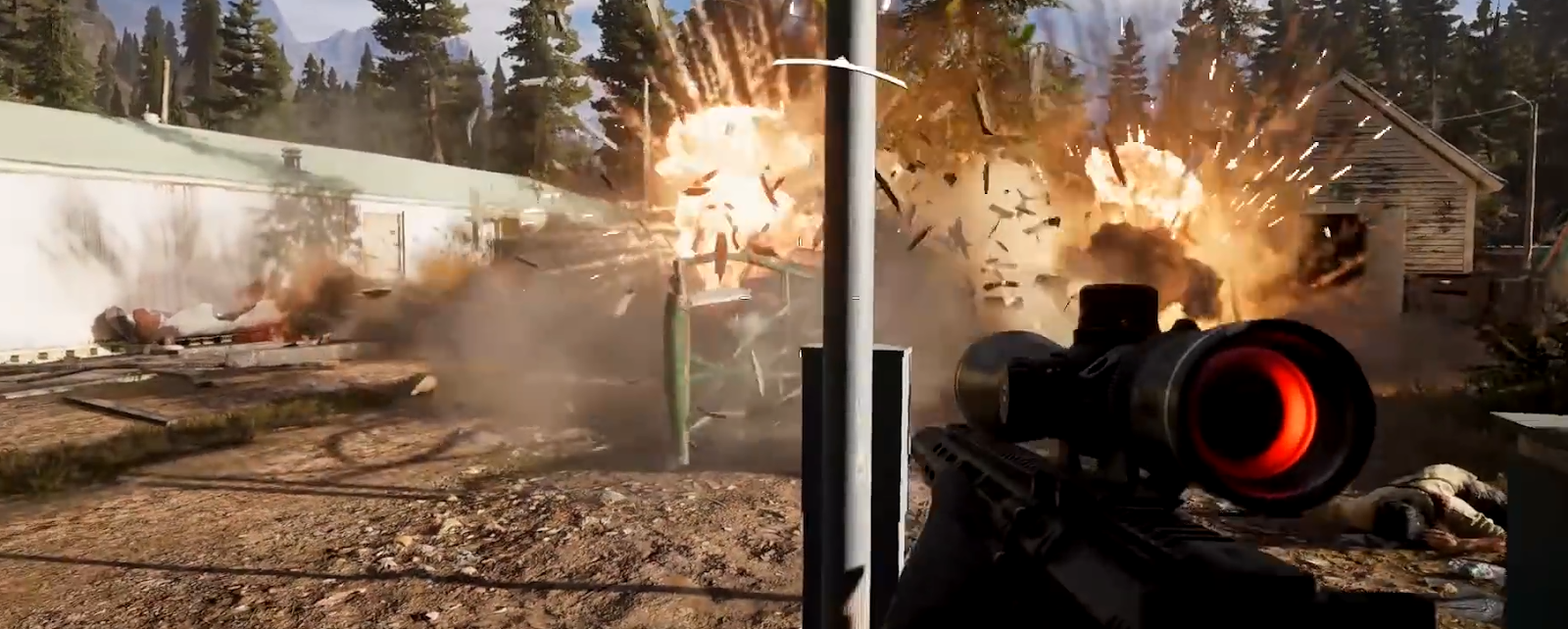
Far Cry 5, like literally every other Far Cry game, is a narrative and setting departure from the previous game; ditching the tropical islands and Himalayan peaks of Far Cry 3 and 4 and setting its vehicle of emergent madness in the vast hills and farmlands of Montana. What I was wrong to expect was that this setting would be less interesting and fun to explore, instead this is easily the most well realised and visually appealing world Far Cry has offered to date. Hope County, like Kyrat from Far Cry 4, is a mountainous, sprawling landscape of forests, rivers and small pockets of civilisation, forests that were, like the jungles of previous games, a complete pleasure to explore, hunt and fight in. also like those previous games, this world is alive; civilians are a common encounter in the game, usually driving on the roads or hiking through the hills, enemy patrols are an even more common encounter, and the world is further populated by a diverse and expansive ecosystem; you'll often run into deer, moose, bears and cougars on your quests. Like all Far Cry games, in fact like all open world Ubisoft games, the world is also filled with filler content; with side quests and mini games covering every square inch of the map, and some of them, mainly the stunt races and fishing, I literally never touched, so I can't comment on them, but they're there. Changes that this game makes to the formula of the series include doomsday bunkers which litter the map and are always loaded with loot should you figure out how to get into them, which isn't very hard. Bunkers, outposts and the specialists have effectively replaced the samey, repetitive side missions of before, and Far Cry 5 does a better job of making you want to find and do these side missions, with the overhauled perk system and the new Resistance levelling system, which I'll get to later. Far Cry 5's world is also absolutely stunning, with amazing water, lighting and foliage effects, not to mention the weapon models, elemental effects and sound design, which are top notch, so in the presentation department, it's Far Cry as usual; a massive, stunning, and dynamic open world that's full of shit to do and sights to see.

The biggest change Far Cry 5 makes from previous games is its complete abandonment of pseudo linearity; 3 and 4 let you do things the way you wanted, but there was always a linear series of story missions to keep the game moving and keep the perks and unlocks coming. In Far Cry 5, that linear series of story missions is completely gone, replaced by the resistance levelling system. Now, every task you complete in the game grants you resistance points, with story missions giving you the most points, and blowing the right shit up giving you the least points. Basically, how this system works is you do things to piss the Seeds off, with the resistance meter being how pissed off they are, and once you've pissed them off enough, they'll send a capture party after you and trigger a cutscene to progress the game's story. This system sounds strange on paper, and it is in practice, but I found myself liking the freedom it offers, as it gives you a reason to do whatever you want, whenever and however you want. This sense of freedom makes the game a blast to play, as Far Cry games are at their best when you're let off the chain and allowed to go crazy, but here, you're never on the chain to begin with, it's great. The sacrifice this system comes with however is a big one, and that's characters and story. Far Cry has recently become defined by its villains, and 5 is no different in that regard, but protagonists have always been a weak point for the series, and 5 is probably the worst offender of this. Far Cry 5's deputy has no character at all; no name, no face, no voice, they exist purely as a vessel for the player, in contrast to Jason and Ajay, which, while weak, still had some form of character growth throughout their games. This may be an extension of the freedom the game extends to the player, even allowing them to pick the gender, but that complete absence of character is felt in the game's supporting characters, which are hard to become attached to thanks to this game's relaxed approach to storytelling, so in the scripted sequences when horrible things are happening to them, it's difficult to give much of a shit. The game's companions are a slight exception to this rule, who are likable for the most part, it's also easier to become attached to them simply since you spend a good amount of time with them during the game.

Far Cry 5's abandonment of linearity leaves the story in a tight spot, as with no linear path to follow, major plot beats are delivered episodically, which is an interesting way to tell a story for sure, but it does make things a little predictable; every confrontation follows a similar pattern, you earn enough resistance points to trigger a scripted scene, the Seed sibling you're trying to kill spouts exposition for a few minutes, usually culminating in a brief encounter with the man himself, Joseph, there's an escape sequence, then you repeat a few times until you reach the boss fight, where you kill them and move on to the next sibling. This isn't necessarily a bad thing, as again, the resistance system really means you can do whatever you want and still reach the endgame, but this style of storytelling is much less involved than Far Cry 3 and 4, 3 in particular, which I feel has the strongest story in the series. What is here is interesting enough; the Cult is interesting in a sort of sickening, barbarous way, though a fanatical, militarised cult torturing and enslaving people on American soil and the US army not going in and Freedoming the shit out of them is really stretching the boundaries of believability. The game, like 3 and 4, comes to be defined by its villains, the Seed family, Joseph and his generals; Jacob, John and Faith. The game makes numerous attempts to flesh out these villains, giving them reasons that they are the way they are, but that doesn't really change much, and none of them are as fascinating as Vaas or as likable as Pagan Min, with the exception of Joseph, though they do have a monopoly on intimidation, as each have their own special way of physically and psychologically mutilating their victims. The scenes where they capture and talk to the deputy are all suitably creepy, with the notable exception of Joseph Seed, the main antagonist, who is creepy for sure, and out of his mind for sure, but what's striking about him is his sincerity. Joseph may be insane like his siblings, but at no point in the game is he dishonest or violent to the player, like Pagan Min in Far Cry 4, his intentions aren't so blatantly villainous, though his actions are indisputably so. The game's villains also embody the game's deeper themes excellently, themes of faith, suffering, and the condition of the human soul, deeper themes delivered with excellent subtlety that give the game a more complex, more emotional undertone that's fantastic to see unfold. And the game's three endings each cast Joseph not as an insane monster, but simply as a man committed to his faith and capable of great forgiveness, it's strange, but I like it, it's why he's so memorable, and why he belongs within the ranks of the great Far Cry villains. About those endings; like 4, this one has a secret ending at the beginning that's technically the good ending, since the other endings are always dark and bleak in some way, but 5 takes that bleakness to new heights with a pair of endings that are positively haunting, and Far Cry 5 is very good at foreshadowing, making both endings satisfying in their own, soul destroying ways, it was in fact the 'resist' ending that motivated me to write a review of the game, because that shit is sticking with me.

Something I've always adored about Far Cry is the gameplay, I've always enjoyed exploring their open worlds, killing bad guys from the shadows with bows and knives, pimping out my guns, and occasionally going completely insane with C4 and rocket launchers, and for the most part, Far Cry 5 is more of the same, but is does make a few decently sized changes. As previously mentioned, the game completely overhauls its approach to storytelling, but Far Cry 5 also overhauls its perk system; in past Far Cry games you would earn XP from killing enemies and completing missions, and that XP would earn you perk points to spend on levelling your character up, usually by unlocking new ways to kill. But in Far Cry 5 you earn perk points by completing challenges, stuff like get X kills with a certain weapon or hunt X of a certain animal, there are dozens of these challenges, and none of them are very demanding, so getting perk points is still pretty easy. Hunting is still in the game, and you still collect animal skins, but the crafting system has been repurposed for crafting throwables like molotovs and dynamite, with upgrades like carrying more guns or ammo now integrated into the perk system, making animal hunting now just a quick way of levelling up and getting cash, while the ingredients needed for crafting throwables are ridiculously easy to find, which disappointed me at first, but I adapted. Exploration and combat still functions the same mostly, though climbing radio towers to unlock new areas in the map menu is gone, stealth still functions the same, with hiding in bushes making you magically invisible, and a white detection bar indicating your visibility that, when completely filled, instantly lets every enemy within a mile of you know where you are. This time though getting spotted is less of a death sentence, and flanking is actually possible since the AI doesn't magically know what direction you ran in like they somehow did in Far Cry 3 and 4, but avoiding detection and going in stealthily is still fun, and going loud is both easier to get away with and more fun to do. Another big change is the specialists, which function similar to the beasts in Far Cry Primal, letting you take a companion into battle for support, though all of these companions function differently and some are better suited to certain situations than others; with ones like Hurk and Nick being useful when causing chaos, and ones like Boomer and Jess being better suited to stealth, naturally I gravitated more to them, them and Cheeseburger, because what's more awesome than fighting alongside a grizzly bear, nothing, that's what. Weapon customisation is unchanged, you can still purchase and pimp out your guns, and you can also buy vehicles now, which also include planes and helicopters, opening up new options for world traversal, though like fishing and stunt racing, I didn't really use vehicles unless the game required me to, I much preferred sneaking through the trees and wing-suiting from place to place. This also increases the chances of finding random events; freeing hostages and blowing up supply trucks, which further immerses you in the world, and gives you more opportunities to earn resistance points. Far Cry 5's greatest weakness in terms of gameplay is, unsurprisingly, the boss fights, which aren't great, though credit where it's due, all the boss fights are unique, but I just didn't enjoy them, I say unsurprisingly because kind of like compelling protagonists, Far Cry's never nailed the art of the boss fight.

Meteorette: Far Cry 5 and the Rejection of Absurdity

Right, time for everyone's favourite part, identity politics. Obviously, I know that identity politics, or politics in general for that matter, aren't tremendously gripping subjects for the common normie, but one beauty of writing is that you can simply not read it, so no hurt feelings if you just skip to the conclusion. Something that's very funny is that Far Cry 5 isn't controversial in any major way, and that that lack of controversy is in and of itself controversial, that may sound insane, but bear with me. Times are troubled these days, Political divisions are more intense than they've been in decades, a chasm no better exemplified than by the 45th President of the United States of America, who depending on who you ask is either the Hero of the downtrodden and the saviour of America, or literally Hitler. It's very well-known at this point that the news media exists in a bubble, an echo chamber of progressivism that's become more and more out of touch over the years, and with this bubble being filled with the same progressive ideas being bounced around endlessly, it only makes sense that an in-group out-group mentality exists, and that political and social bodies outside of their in-group are hated and condemned, hence Trump is literally Hitler. Then along comes Far Cry 5, a game set in the heartlands of America where you're fighting a religious cult, marking the first time Far Cry hasn't been about killing minorities, as if that's ever been what Far Cry was about, as if they weren't slave traffickers or loyalists to a despotic king. But as I was saying, game journalism is very much trapped in the same ideological bubble as the rest of them, they eat up piles of shit like Gone Home and Sunset, and find reasons to hate games like Cuphead because it's too hard for them, because, as has been made very clear by games like Doom and Cuphead, but more importantly by Gamergate and the 'Gamers are dead' debacle, these game journalists aren't actually gamers, and they care more about their ideology than they do the games. They adore games that are political, because they care more about the politics, and a game that confirms their biases is deserving of praise, while games that challenge their ideological values are deserving of scorn *cough* The Last of Us Part 2 trailer *cough*.  So when Far Cry 5 drops the player in the middle of redneck country and tasks them with taking down a gang of bible-bashing loons, they saw what they wanted to see; a game that would provide relevant political and social commentary on America's horrible racism and sexism, and the evils of gun ownership and white supremacy in Trump's America, this wasn't reflected in the marketing at all, but it's what they wanted, then the game dropped, and it wasn't what they'd hoped at all.

Social Justice is the enemy of entertainment, I've made this very clear over a myriad of posts on this blog, but for the uninitiated, here's the rundown. Social Justice ideologies like Feminism are essentially religion, in it is a collection of beliefs and tenets, scary truths about the world that they fight or protect against out of virtue. Where this becomes religion is in said scary truths, things like Patriarchy and the notion of the progressive stack, ideas that are frankly absurd because they look at demographics as classes and deliberately confuse the individual with the collective; for example men as a class have privilege because they make the overwhelming majority of business and political leaders, they say while also being wilfully ignorant of how they also make up the overwhelming majority of workplace fatalities and homeless people, a lie by omission that, if acknowledged, would discredit their notion of male privilege. The progressive stack enables them to tilt the scales through their redefinitions of privilege and discrimination, putting women, minorities and the LGBTQIXL12345 community higher on the ladder of societal victimisation to justify granting them actual privileges in opposition to the preserved privilege of the bottom of the ladder; white, heterosexual, able bodied men. This rather horrific way of determining importance based on arbitrary characteristics that have been redefined into classes is the root of Social Justice in entertainment; male majority is interchangeable with male dominated, deliberately implying the existence of a power structure within these genres or medias, or in managerial positions and Presidents in the real world, one they can then say is unjust and must be changed, rather than the result of a free market. It's the historical oppression of women that makes Wonder Woman the best superhero movie ever, until Black Panther becomes the most important because of the historical oppression of black people, and because representation matters, apparently, but it's all just a Torjan horse; a way of praying on people's better nature in order to achieve the true goal, the propagation of the agenda. Social Justice doesn't have a grasp on subtlety however, and fiction that promotes Social Justice values almost universally fail, not because people are complicit in injustice, but because they don't like being preached to by people looking to victimise or villainise them. And the danger this poses to a game or movie, as is painfully observable in my favourite dead horse; Ghostbusters, a film that's very creation was spawned of Social Justice, entertainment embracing and flaunting its political agenda, especially an agenda as unpopular as Social Justice, is suicidal, to court Social Justice is to court a PR disaster.

Say what you will about Ubisoft, but with Far Cry 5 they no doubt saw that damaging their public relations wasn't a good idea when the goal is to sell millions of copies of a game. Far Cry 5 takes the bold stance of not taking a stance, it provides no social commentary on Trump's America or racism or xenophobia like the journos hoped, it has nothing to say, one way or the other. The closest that it gets to even touching real world politics is Hurk Sr's senate campaign, an optional couple of missions where you are tasked with disrupting the democratic process through gerrymandering, a mission that sounds political, but is played purely for shits and giggles, as you kill cultists and listen to Hurk Sr. complaining about "Obama lovin' libtards," almost like it was going out of its way to make a mockery of both sides of the isle. The game doesn't swing in either direction, it doesn't spout left wing or right wing politics, and it's actually quite impressive that the left wing journalists have made such an issue out of the game being politically neutral, almost as if they were expecting the game to confirm their biases, and are butt hurt that it doesn't. The developers of the game seem to have made a conscious effort to make Far Cry 5 as apolitical as possible, a move that may simply be to not piss anyone off like some journos claim, calling the game "sanitised" and "timid", but it may be far more than that. The story that the game is telling isn't one that concerns itself with the current, petty issues of our time, it has nothing to say on politics or race or gender because that's not what the game's about. The game, fundamentally, is a story about faith and suffering; Joseph and his family have suffered, and it's turned them into monsters who bring suffering to others, while seeking righteousness and purpose in faith, a road to hell paved with good intentions. Its most profound message is one of humanity, of how we are animals doomed to repeat our mistakes and create our own demons, and of how decadence has driven the world (as greatly exaggerated in the game) to madness. These ideas do not need an understanding of current events to pick up on, throughout the entire game there is a subtle but inescapable sense of dread, established through excellent foreshadowing, and that is something that anyone can get their head around, without being lectured about how racist rural America is, or how evil guns are. One of Social Justice's ultimate failures is its shallowness and its pettiness; making mountains out of molehills because it's easy while the world around them figuratively, or in the case of this game, literally falls apart, and Far Cry 5 isn't the first game to call attention to that through its refusal to be political, and its unflinching goal of just telling a story, because the people who wrote it aren't petty and shallow, they have something more important to say, a subtlety only noticeable to the people looking for it, and a subtlety that can and will be understood long after the political divides of current year have been consigned to history.

When the World Falls into the Flames
Far Cry 5 is a game that I will admit to becoming addicted to, I played and beat it in four days, across five six-seven hour sessions, and when the game ended, I couldn't think of words to describe how it made me feel. Like its predecessors, it struggles to create and develop meaningful characters outside of its villains, who are once again the standout characters, and who once again are more complicated than your simple baddie. A big loss for the game's storytelling is the complete absence of character for the Deputy, who is majorly lacking the subtle character arks that Jason and Ajay had in prior games, a choice that doesn't make a lot of sense to me, even considering the basic customisation you are given for them. But even without a character ark for the hero, the game still manages to convey deeper themes with admirable subtlety that give the game a great deal of depth for those willing to find it. But more importantly than all of that, Far Cry 5 is a really fun game, little has changed in the Far Cry formula that has persisted for the last five entries, but what has changed has been improved for the most part, streamlining the hunting, perk and exploration systems, while keeping the game's fun, if occasionally inconsistent stealth, and further facilitating the blowing up of shit through the specialists. The game also takes an interesting approach to storytelling that has its strengths and weaknesses, but the system works well enough to convey a decent story, while also allowing as much freedom to the player as possible. The game's world is also gorgeous, huge, and full of filler to keep you playing, it's just an all-round fun game to play, excusing the boss fights, it may even be the most fun in the series. The game steers clear of politics at every turn, and while that seems to be an issue for other people reviewing the game, I admire Ubisoft for that decision, keeping any politics or bias out of the product. It's biggest flaws for me are its weak heroes and non-existent character in the Deputy, but I can ignore that while shooting down helicopters or getting pecked to death by a pack of angry turkeys. Again, excusing the boss fights, I had a blast with Far Cry 5, and I can't recommend it highly enough, it's definitely worth playing.

Monday, 26 March 2018

Pacific Rim: Uprising movie reivew

Here's what you need to know; it's been a decade since humanity closed the Breach and won the war against the Kaiju, but while some areas of the globe have been propelled forward to a brighter future, vast areas of the Pacific coast are still struggling to recover. The victory also brought with it however a new wave of Jaegers, ranging from tiny one-man rigs built from scrap, to building sized automated drones. But while the contentious drone program ignites debate in the PPDC, a new threat emerges from the depths of the Pacific, one that may herald the return of the Kaiju, and leaves the survival of all life on Earth hanging in the balance.
So Pacific Rim 2 finally got made, and I should be happy about that, so why aren't I? My concern was obvious; Del Toro not directing this sequel was a huge red flag to me, as Pacific Rim could easily have been garbage were it not for his masterful execution, but while he was off making a best picture winner, Pacific Rim 2 looked to be helmed by a first-time director and a studio still craving a taste of that MCU magic. But the important question is is Pacific Rim: Uprising good? Now that's a question.

This film raised my brow right out of the gate, showing footage from the first Pacific Rim in a prologue sequence. I knew this wouldn't bode well for my enjoyment of the film, though I know it's there as a sort of 'previously on' to catch the audience up. I thought it would be like being reminded of that amazing Indian restaurant you went to once before tucking into a cheap takeaway curry, and sadly, as you will learn throughout this review, I was right to think that. Let's start with the characters in the film, not exactly the first film's greatest strength, so it could only get better, right? John Boyega is great as usual, and is very charming as Jake Pentecost, Idris Elba's character from the first film's son. It's good that he's such a likable guy, as he gets all the screen time, which isn't all that untrue, it's about 70%, I do prefer him as a hero to Charlie Hunnam's Becket, but that's no doubt down to John Boyega's coolness rather than any kind of improvement in the writing department. But him hogging the screen time kind of leaves the rest of the cast in the shade, and like the first film, most of the supporting cast gets the short end of the stick in terms of character development. This film's Mako is a little girl named Amara, played by acting newcomer Cailee Spaeny, and just like Mako, she has a troubled past with the war and the Kaiju, one that at least explains her motivation for building a Jaeger, though not necessarily her means. Scott Eastwood's Lambert is, in the same vein as Jake, a likable enough character that's lacking in depth, the two have one good scene together, but the film doesn't give him much to do besides being Jake's co-pilot. Mako returns, for five minutes, and is given pretty much nothing to do, and the training Jaeger pilots are given very little development, besides the one who, in a totally untropey way, is adversarial to Amara, there's also a similarly tropey kid who's nice to her. Then there's Newt and Gottlieb, the scientists from the first film, Gottlieb's actually pretty good, and has a great line about having nightmares from when they drifted with a Kaiju. Newt on the other hand; on paper, what they do with him is a smart idea, but in execution, it's bloody weak, the film completely fails to explore any sort of character struggle with him and turns a potentially brilliant plot twist into a contrived joke.

Let's talk about that plot, as like Newt, a lot of what it puts on the table is great on paper, but weak in execution. The drone program for example, an interesting idea, if not exactly a new one, about the threat posed by automation. What's weak about this is that the entire drone program is revealed to be a red herring, and not a good red herring, but a daft one. The plot twist is great on paper, but when it comes to fruition in the film, you're just left asking why, it's contrived. The first film wasn't above this; what with the Precursors actually being dinosaurs, but at least that film never broke its own rules, unlike this sequel. Gone are the days of "the deeper the bond, the better you fight," now any pair of drift compatible pilots can be put in a Jaeger and be completely fine, now the size of the Jaeger is important, and one small enough can be piloted by a single person, so all that neural load stuff is nonsense because you don't even need the drift to interface with a Jaeger. Then the film does some retconing that makes literally no sense in the context of the first film, which already didn't make a lot of sense because again, the Precursors were dinosaurs. The film even tries to replicate the emotional beats of the first film, with a tragic drift flashback similar to Mako's in the first film, and a speech before the big finale, the problem is that Amara's flashback conveys nowhere near the same sense of fear and dread that Mako's did, it wasn't scary like Mako's was, and while I like Boyega in the role, he's nowhere near as good of a speech giver compared to his dad. And to top it all off in a nice little package, the film even has a stinger, because Universal still want their own MCU, apparently. All of these problems could be swept under the rug if the film wasn't so try-hard, if it just existed to be a vehicle for the monster mash, like the first, it would have been easier to forgive the problems, but that need to set up a lore and to build the groundwork for a franchise means the film takes itself too seriously, and that approach doesn't work when it's giant robot men fighting interdimensional Godzilla monsters. The film lacks the sense of levity that the first had, it's not as fun.

Pacific Rim was not above being easily nitpicked, it was a flawed film; like its sequel, its characters were weak and its story was daft and dumb. The strength that Pacific Rim had however was Del Toro, the man, the myth, the Mexican who is a master behind the camera, the film was visually stunning, polished to near perfection, and oozing with style. Guillermo del Toro has yet to make a film that isn't fantastic in my eyes, Steven S. DeKnight on the other hand is someone I've never seen before, as his background is in television, with which I'm not very acquainted. Visually speaking, the film doesn't venture too far from the aesthetic established in the first film, though the effects don't look as good this time around. The problem is that the first film was all style; the film was aware that it was dumb and shallow, and prioritised being fun as hell, which it was. Pacific Rim: Uprising however has a cinematic universe to set up, and so takes its story and characters more seriously, while somehow managing to be even shallower than its predecessor, this is a bad combination, as it makes you question the film more, and thus see its flaws more clearly. Like Pacific Rim, Uprising's greatest strength is in its action; now throwing in some Jaeger on Jaeger before the big Godzilla battle in the climax, but without Guillermo del Toro at the helm, it feels like something is missing. The effects aren't as good, the explosive visual style and crushing brutality of the fights is effectively gone, as silly as it sounds, the film just isn't as magical as the first. The fights themselves are entertaining when they're on, but it's a bit like the two American Godzilla's, where one (2014) is a visual feast in the Godzilla scenes, and the other (1998) is just turn your brain off action in the Godzilla scenes. Pacific Rim had style, Godzilla (2014) had substance, Pacific Rim: Uprising tries to have both, but in fact has neither. And something that just boggles my mind; the music from the first film is barely used, the first film's crazy awesome badass theme that makes all who hear it's testicles quadruple in size is used once in the sequel, and not even in an action sequence, but in a montage of the characters repairing their battered Jaegers, which makes it start to look like they were actually trying to suck the magic out of this franchise.

Pacific Rim: Uprising doesn't improve on the first but does succeed in being inferior in pretty much every way. Charisma alone makes Jake a more likable character than Becket, but the sequel still struggles with weak, poorly developed characters, moreover it still struggles with a plot that doesn't make a lot of sense, only with the added hindrance of trying to be serious and set up a Pacific Rimiverse. The Sequel also has the same strength as the first, but again there is the hindrance of the polish and style of the auteur being noticeably absent without Del Toro behind the camera, the film just isn't as cool. The contrivances of the story are made almost impossible to ignore, and the film squanders any potential that it had with lacklustre execution. It's watchable when shit's going down, but in the end Pacific Rim: Uprising just feels like a knockoff, a lower quality clone of its predecessor, a feeling that I couldn't escape once I was out of the theatre, and still can't. Pacific Rim: Uprising is serviceable, but it could have been and should have been so much more, and I personally wouldn't recommend it.

Saturday, 17 March 2018

The War on Pornography: a long series of thoughts

A long time ago (in blog years) I wrote a post titled 'The Conservative Party's war on Porn,' in which I rambled for a few paragraphs about the Conservative British government, headed by David Cameron and then by Theresa May, making numerous attempts to limit, restrict, and control the production, distribution and availability of internet pornography, and how it's a slippery slope of the government slowly taking away people's freedom to consume media. Well, it's over a year later, and me from back then would have hoped that Theresa May's government would be concerning itself with the largest political event this country has seen in decades. But instead Brexit is at a standstill, and Theresa May is proving herself again and again to be too weak to really get anywhere against the European Union. It's already clear that she also has no clue how to properly manage her priorities, wasting time with a pointless and disastrous (and hilarious) election, and attempting to implement the same intensely dubious policies that made me hate this party to begin with. This will be a much broader post than before though, I'll be talking about the Conservatives, but also about violent media, feminism, governmental control of the internet, the influences religion has on society, and porn of course, it'll be really long, so buckle up.

First up, some backstory, before the election results were in, I was expecting the Conservatives to win a bigger majority in parliament, since the closest thing to a viable alternative was Jeremy Corbin, everyone's favourite socialist, I didn't think it was going to be a contest. I still thought they'd win, despite the Conservative manifesto, a cancerous mess of proposals and policies that I'm sure Supreme Leader May thought she could get away with while simultaneously kicking the Labour party while it was down in a landslide victory. That didn't happen however, as the election turned out to be one huge, glorious own goal for May, who lost the party majority that the Conservatives already only barely had, leaving the British parliament in a tight stop, and crushing Supreme Leader May's dreams. As you may or may not have noticed, I'm not a big fan of Theresa May, the reasons for this are numerous, but chief among them is the simple fact that I do not trust her; I never have, it seemed iffy enough when a remainer became the head of Britain's Brexit government, but even before that, I've never seen her as truly having the needs of the nation as a major priority, she's sneaky, Machiavellian, and borderline authoritarian.

My outlook changed slightly with the election, as I no longer saw her as simply borderline authoritarian, but full on authoritarian. Sure, there was the myriad of plans that were miserly and stupid, like free school breakfasts and lifting the ban on fox hunting, which no doubt turned off a bunch of parents and animal lovers, and the unfortunately nicknamed dementia tax, which was an abject disaster, but none of that bothered me more than the internet policies, which were monstrous. This was supposedly a response to the rising threat of terrorism, but I highly, highly doubt that having regulatory control of the internet would make that threat just go away, I said this before about the Investigatory Powers Bill, terrorism is just an excuse. The plans included, but were not limited to, banning the development and distribution of secure software, which sounds real secure don't it, going after closed platforms like game consoles and mobile phones, and, my personal favourite for its sheer lunacy, confiscating foreign nationals' smartphones while they're in the country. You don't have to be a genius to see the holes in these plans; taking people's smartphones is absurd and banning secure software and closed networks is a perfect climate for surveillance, interception and cyber-attack, but it gets worse, as impossible as that may seem.

The regulatory power and intentional crippling of security would effectively grant the Conservative government complete power over the internet, which is more than a little unnerving. Like I've said before, many times, government should not have the power to control or regulate its citizens' consumption of media, though both the Conservatives and the Labour party have been doing that since the days of Tony Blaire and his hate laws. But with the power that the manifesto proposed, it would spread beyond what people can and can't say, extending to what people can see, which is where we finally get to the topic of pornography. Over the years, as I rather insufficiently recalled in my last post on this subject, the British Government seems to really take issue with pornography, and while it has since the dawn of online porn's massive availability, I focused exclusively on the current Conservative Government's puritanical pearl clutching and efforts to kill porn in the UK. I will now outline my stance on the matter of pornography for the sake of clarity, in my opinion, porn is neither a benefit nor a detriment to society, but simply another industry, like books, movies and games, it's a product, though one that, due to its inherently sexual nature and the awkwardness surrounding it, receives far less attention in the public consciousness.

Which is precisely why, as I said last time, it's bound to be mommy state's first target. The public at large doesn't really discuss porn, since it's a bit of a taboo, but what that means is if/when the government makes a move to destroy the porn menace, while smaller voices will speak up, there with be no major resistance from the wider public, after all, it's only porn, and the only people who watch porn are sad, lonely basement dwellers, right? The threat here is that when mommy state has the power to take one thing away, they will inevitably start going after other industries and mediums, it's a slippery slope argument for sure, and porn isn't banned just yet, it's just getting a notoriously censorious organisation put in charge of its regulation, but porn would just be the start. In this case, how long would it be before they target the corruptive force of violence in the media; shooters and action games would have to be censored and regulated because they encourage violence, but the rabbit hole would just keep going deeper from there; for instance, in driving and racing games you can drive irresponsibly, in RPG's you can make morally dubious decisions, and in a certain popular puzzle game there's cute little talking gun turrets, once you can justify censoring one corruptive force, you'll inevitably be able to justify censoring them all. This would be the inevitable end of government control of the internet, China style censorship and regulation that would result in a far smaller, far more restricted internet, where the Government has control over media distribution and consumption. YouTube would be heavily policed or gone because of the Alt Right, Twitter and Facebook would be gone because of all the hate speech, search engine results would be heavily filtered, and porn would simply not exist, because it's dirty and dangerous to the kids, as is Call of Duty and Marvel movies, because they're violent. And at that point, who knows where it would stop; smoking can cause cancer, alcohol can fuck up your organs, and high fat and sugar foods can cause obesity, these are areas that the government is already making moves in. It really becomes a matter of how much freedom the state thinks it can trust its citizens with, since their agency might lead to them making bad decisions, and that's charitably assuming that their intentions for such authoritarianism are good.

Yes I sound like a tin foil hat wearing conspiracy nut right now, but going back to my thoughts on Theresa May, I do not trust her, though I would absolutely trust her to find justifications for ridiculous and tyrannical policies, like, for example, using terrorism as a justification for taking over the internet, and my distrust of her would make me more than comfortable to believe that her scheming wouldn't stop with the conquest of the internet. This has been made painfully observable in just the last few days as of me writing this, with Canadian activist Lauren Southern being detained and denied access to Britain on suspicion of terrorism. As absurd as it sounds that a young, sexy libertarian from Canada can even be considered a terror suspect, the apparent reason is her previously distributing 'racist' flyers stating that Allah is a gay god, like that has anything at all to do with racism and isn't a blatant admission that some ideas are above mockery in this country. Not to mention how it looks that British border police are arresting right-wing activists, given how they treat right-wing activists like Tommy Robinson within the borders, I'm firmly dissuaded from believing that there's no political bias involved. The justification is a moral panic; Lauren Southern wants to spread racism against a religion, Theresa May has tried to exploit hysteria about terrorism to push dangerous online policies, David Cameron, throwing in a twist, attempted to justify his porn policies by trying to cause a moral panic *cough* "normalising sexual violence against women... poisonous to the young people" *cough*. And this isn't unique to Britain either, with both major parties in America trying to use the moral panic around guns to push their own agendas, be it trying to amend or repeal the second amendment, or using it to push for censorship in the media. But when it comes to guns and violent media, there's a correlation causation conundrum, school shooters may play violent video games, but that may simply be incidental, and omit contributing factors that take far greater precedence, such as a person's mental or emotional wellbeing, mental or personality disorders, and external factors like abuse and stress. It also fails to consider that violent video games are played all over the world, but shootings are significantly more frequent in the United States, which has more relaxed gun laws compared to nations like Britain, implying that it's much more of a gun issue than it is a video game issue.

Getting back on topic, I did a bit of info digging, as is only right when trying to be assertive on a topic, and what I found was genuinely surprising. In secular, developed parts of the world like America, Britain and Europe, Pornography has generally more relaxed laws around it in comparison to more theocratic and or less developed parts of the world, like Africa and the Middle East, where porn is illegal in most nations, again though, we face a correlation causation conundrum. Here's the conundrum, and I included a couple of world stat maps for visual reference, with the bottom one showing Suffrage by country and year. There would appear to be a correlation in these maps; more secular, developed nations like America, Britain and the European nations, who reached suffrage earlier and rank higher in gender equality than African and the Middle Eastern nations, also have the most relaxed pornography laws. The cause of this could be many things, one such possibility is that this reflects the development of liberal and egalitarian values across the globe with regards to women. Meanwhile in less enlightened parts of the world, like the highly conservative and theocratic Islamic states, women's liberties are severely restricted, and coincidentally, so is access to pornography. What this implies is that as a nation becomes less religious, like a lot of western nations are doing, traditions and beliefs of modesty become more relaxed, and beauty starts to be embraced more hedonistically, in other words, people like looking at naked people, and god can no longer tell them that they can't.


The modern world is slowly losing its faith, to a heathenous non-believer like myself, that's a good thing; old, unchallengeable ideas and structures being phased out and replaced by new ideas in a new, more scientific and technological world.  The problem that losing religion comes with is the loss of absolute morality, among other things; while faiths like Christianity and Islam provide rigid, god-ordained codes on what is good and bad, the atheistic mindset of there being no god delegitimises said god-ordained codes. Unlike what hardcore believers say however, people not believing in god doesn't completely destroy society, since we can all generally agree that things like murder and theft are wrong, ideas born from religion that have since been passed down through culture and enshrined in law. But unfortunately, nature is violent, and humans are animals. To compare this to something contemporary, in The Walking Dead, society has been completely destroyed by a zombie apocalypse, inherited religious morals like murder and theft are pushed to their extremes as people fight to survive, and in season 8, there is a war going on, between a collection of survivor colonies that are trying to uphold pre-apocalypse morals and values, and the Saviors, a colony that has abandoned many pre-apocalypse values in favour of a cult of personality surrounding a violent and autocratic warlord. At the core of the war is a clash of ideologies; with Alexandria, Hilltop and the Kingdom all still holding onto a pre-apocalypse societal model, and the Saviors structuring their society into a rigid hierarchy, with Negan and his inner circle at the top, and other colonies that they have enslaved through violence and fear at the bottom. This is common in post-apocalypse stories; violent autocratic systems of governance rising to power, might making right, with the apocalypse restarting a survival of the fittest mentality. And among the survivors, there will always be loyalists; not just people who group around the strongest and fittest to ensure their own survival, but in the case of systems like the Saviors, perhaps to also find a sense of order in the chaos of nature, a guiding hand, or rather a barbed baseball bat, to help them make sense of the world.

There was a point to that little digression, I swear. While humanity is made equally in the eyes of the law, or at least they should be, they are not and will never be made equally in the eyes of nature, there will always be strong and weak, there will always be leaders and followers. This is where religion, and eventually modern ideological movements like Feminism come into play. A desire to make sense of chaos is one of the reasons Religions have so much appeal; they provide answers, as well as providing absolute morality. In this sense, ideologies like Feminism are modern religions; as they provide answers that make sense of the world, although in the case of feminism, those answers almost never make sense, because like religion before it, it has a habit of getting cause and effect mixed up. Feminists, for example, see the discrepancy in average earnings between men and women and assume that this is by design; the pay gap, they go on the assumption that it's by design for the same reason that a creationist assumes that the human body was designed, they believe there is a higher power. The key difference here however is that in the case of creationists, that power is a benevolent god, while in the case of feminists, that power is a malevolent, oppressive system; the Patriarchy, but both groups are doing the same thing, looking at something that doesn't appear to have a natural reason for being, and therefore inferring that the reason is not natural. Ignorance plays a big part in this, for obvious reasons; with both groups using confirmation bias to support their conclusions. But there is another sense in which Feminism is a religion, and that is, of course, morality, which is where Feminism goes from stupid to sinister.

Feminism, like Christianity, has encoded in its core beliefs a system of morality. Feminism, like Christianity, has an enemy. The Patriarchy, by the feminist definition, is a gender-based hierarchy that values men over women, and in which men have most, if not all the power. Feminism has, however, become a joke on the internet over the last few years, as their version of Satan has been repeatedly and mercilessly refuted; there is no such thing as the Patriarchy, as a system that values men more than women would never allow for such a huge discrepancy in workplace fatalities, homelessness and violent crime victimisation, let alone grant women the right to vote and run for office. And since it's very creation, Feminism has held, if not been completely built upon anti-male sentiment, taking the social justice approach that states that the oppressed can hate their oppressors, and that men are the oppressors, thus it's okay to hate men, like this lovely pair of cunts protesting Father's Day. In this oppressor-oppressed system, women are naturally the oppressed, and face all sorts of injustices at the hands of society, which is where feminist morality is rooted, things such as the dreaded male gaze, the immoral act of men liking sexy women, which is where Anita Sarkeesian's push for feminism in gaming is rooted. Men like sexy women, but this is objectification, dehumanising women for the pleasure of men. And hence, in Sarkeesian's mind, sexy women in video games is wrong, as is depicting men in powerful or dominant roles, as they enforce "harmful" and "problematic" gender norms in the "presumed straight male player". This positively poisonous mentality naturally spills over to other medias, films, books, and even music, and if it's morally wrong to portray women as sexy and to portray men as powerful and dominant, because sexy women is objectification, and maleness is toxic, that effectively makes Pornography, an industry built entirely on sexual desire on appeal, the literal manifestation of evil.

There is another thing Feminism has in common with religion, and that's its ability to influence politics. The ideology preys of the good intentions of people around it by trying to secure a monopoly on ideas such as gender equality, after all, you want women to be equal, right? But that's only what the dictionary says Feminism is about, as I said before, for decades now, Feminism has been a distinctly anti-male ideology; proclaiming that all men are sexist and that they need to sit with their legs together on public transport because their anatomy is sexist, lest we forget the absolutely abhorrent Feminist beliefs that all men are potential rapists and abusers, and that men are never victims of anything ever, never mind all the homelessness, domestic abuse perpetrated by women, and that in countries like mine, it's legally impossible to convict women of rape, because equality. So when feminism uses the goodwill of the normies to get itself into high places like politics and industry, that toxic mentality can start doing some serious damage; like not funding abuse shelters for men, enforcing gender equity policies that throw meritocracy out of the window and breed mediocrity, and spew out propaganda about "toxic masculinity," about manspreading and mansplaining and using questionable or outright false statistics to make the genders afraid of each other. Their Feminist puritanism naturally therefore starts to spread to media policy; which usually ends in censorship, yay. You can no longer show women who are weak, feminine, sexually appealing or subordinate, as that would be sexist and immoral, meanwhile you also get strongly discouraged from showing men as strong, masculine and in a leadership role, because that promotes harmful, patriarchal, misogynistic and bla bla bla. And again, if portraying women as sexually appealing and feminine is immoral, then you're bound to think that porn is the worst thing in existence, and if you're a feminist activist or politician who can influence policy, there's no limit to how far you can spread the cancer.

In the past, it was religion that tried to strangle porn, because it was against the will of god to indulge in the pleasure of human beauty and sexual desire. But the rise of the internet has led to an explosion in availability of all kinds of products and medias, a product of more enlightened and technological world. But with the decline of religion came a loss of divine morality, and a spiritual vacuum that was always going to end up being filled, be it by another religion, or by a new belief system built upon a similar framework to religion. In the secular western world, that vacuum came to be filled by progressive ideologies, one such being Feminism, an ideology every bit as hostile to pornography for remarkably similar reasons; because they too believe that indulging in sexual desire is immoral, though because of Patriarchy rather than the word of god. Feminism is also very good at infiltration and has managed to infest numerous industries and implement policies that sate their beliefs, while feeding on the goodwill of everyday people. This scheming isn't unique to Feminism however, as authoritarian politicians are everywhere, ones who have their own agendas and beliefs, and will use any justification to push their agendas at every turn; censoring media, banning journalists from entering the country on politically motivated grounds, increasing their own power, and targeting industries that they deem immoral and corruptive. One such politician is our current PM, Theresa May, whose grossly authoritarian and miserly policies cost her party their majority in parliament, a much-deserved self-inflicted wound. Her priorities are backwards in the age of Brexit, as like the last few PMs before her, she's out to control the citizenry's consumption of media, and sees Porn as an easy target thanks to the public apprehension surrounding it, and an obvious target in a new age of feminist and progressive puritanism, of which I highly doubt she isn't a firm believer. The AgeID system may not be a ban, but it's a policy that, once in place, will be there forever, and will inevitably be expanded upon in the future, it's just another step towards that ban, a ban that would be a victory for censorship, and the start of very long, very dark road.

Now, assuming you've made it this far, you may think this incredibly long screed to be a stroke of genius, or the ramblings of a maniac; one deeply delusional and paranoid, and who thinks that the Government wants to delete his digital spankbank. If you think that of me, I'm fine with that, but my intention is to be honest, right or wrong, about what I think of the war on pornography. Really, it's not a war on porn at all, but a war against the open consumption of digital media, which I why it should worry you as it does me, because the tendrils of censorship are always looking for new things to strangle, and it's reaching would never end with the destruction of porn. As usual though, feel free to disagree, and thanks for reading.