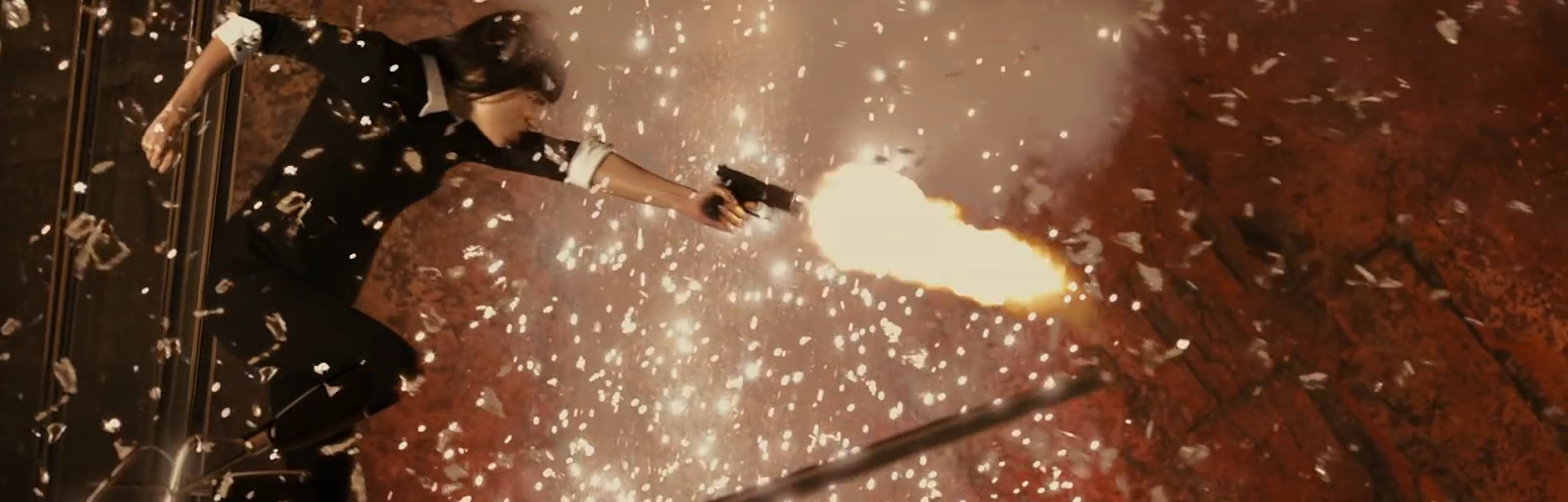
Here's what you need to know; after a storm kills the power to the town and puts a tree through his window, David and his son drive into town to get supplies, but while shopping for supplies at the local supermarket, a thick mist roles in and blankets the area, confining David and his fellow customers to the store. But this is no ordinary mist, something otherworldly lurks just beyond the sheets of glass lining the store's front, and it's hungry. As the world outside becomes more unrecognisable, and social order falls apart inside the store, David and a small group of other survivors try to figure out away to stay safe, not just from the monsters outside, but from the monsters inside too.
Over the years I've watched many horror films, some of them are total shit, others are excellent and intense horrors that get the heart racing, and I've loved many of them. But rarely does a film scare me, as in bother me on a personal level. And for this spooky season I've gone and watched one of those films, a little old Stephen King film called The Mist, and it was spooky, so let's get stuck into this nightmare of movie.
The Mist actually doesn't start off that strong, instead it starts slow, there are a few neat Easter eggs if you're a film and or Stephen King buff, but the characters are very standard, which since this film is clearly going for representing normal people, isn't a bad thing, David's a happy dad with a happy wife and kid living on the edge of a lake, and he has a not so solid relationship with his neighbour. The film's first 10 minutes does set up a feeling of normalcy quite well, but that doesn't make it tremendously gripping to watch. This film then, quite sharply, takes a turn for the more intense when the sirens go off and the mist roles in, and this film becomes a study into humanity. As the film progresses, David is the most prominent character, though I think protagonist might be a stretch, because the protagonist is a collective, it's the supermarket and everyone in it. David keeps the film's plot going as he tries and fails to maintain order and keep his son safe, while being the audience's every man in this crazy situation, exhibiting traits entirely normal to the vast majority of us, but that are sinfully portrayed in this film's very religious themes. Andrea from The Walking Dead's in this movie, as well as a few other Walking Dead faces, and she, like David, serves more as a perspective for the audience than a character. The closest thing to characters the film has is metaphors, which is something I'll explain later, but from a character standpoint, this film isn't very good. Where this film shines is in a fairly standard sounding plot, a group of people trying to survive the monster attacks, but on a deeper level, really takes a long, hard, very uncomfortable look at our nature, and it is gripping. The film explores a host of possible reactions to this kind of scenario, all represented in the individual people in the store; the reality denying sceptic, the religious fanatic, and all the areas in between, as all the scared people in the store try to make sense of the mist. It only gets more gripping as a cult mentality begins to develop, and the people really start to lose their minds, even resorting to murder to survive. In the middle is people like Toby Jones' Ollie, who does a good job of explaining all of this madness as the film goes on, insightful to the point of breaking the 4th wall, and thankfully the only one with a gun. It's almost like he, the character of Ollie, knows how stupid we are as a species, even calling us fundamentally insane at one point, and seeing this large group of people all from different walks of life find their own way of getting answers is absolutely fascinating, and terrifying. While the film does seem on the surface to be anti religious, it really isn't, instead the film treats religion as just another option, every bit as valid and right as scepticism, survivalism, and nihilism, which is to say not very, because you'll die anyway. Yes, it's bleak, very bleak, but it's this film's greatest strength by far, the Lovecraftian concept that in the larger universe, full of monsters and demons we will never understand, humanity and all its little problems are insignificant, and that when faced with our own insignificance, we lose our minds. The film's ending really hammers this point home in one of the most gut punching final scenes I've ever seen, as David, and by extension the audience, realises the futility of it all, it's actually hard to watch, and I 'love' it, I guess, that really doesn't feel like the right word.
The Mist, being a decade old, has the benefit of being a small film in terms of scale. Most of the film takes place in the store and the surrounding area, which was probably very convenient for the filmmakers, but it also gives the film the benefit of a feeling of confinement, which is perfect. Also beneficial to the film is the Mist itself, giving a good excuse for aging CG, and really adding the feeling of confinement and Lovecraftian otherworldliness of the monsters, which the audience rarely gets a good look at. When the monsters are on the attack, they're the star of the show, done largely with CGI, it's fortunate that the CGI still doesn't look bad, and the monsters themselves look really cool. The film's monsters very effectively perverts earthly concepts, like annoying flies, turned into a giant, winged killing machine, it makes spiders as big as dogs and gives them acidic webs and a really fucking creepy set of human teeth, and brings in reptilian alpha predators that make for one of the film's most exciting moments. This is a smart move, as it makes the monsters simultaneously natural, and yet monstrous, perverted, beautifully complimenting the Lovecraftiness, as it turns the natural hierarchy that man's on the top of on its head. Despite being very reliant on CG for its effects, the film actually doesn't have that much in the way of effects; there are sequences where they're used heavily, as the monsters tear shit up, and it's entertaining and creepy and usually very gory, but they're only the star in those scenes, you leave the film with its philosophical and psychological mindfuckery on your mind, and that is unquestionably the point of the film, and it's greatest strength. That could leave some people disappointed if they don't know what the film's really about though, I personally don't see how someone could be bored by this film, but it's hard to market this film as a creature feature, because it's really not that. One issue that can be gleamed, if I have to find one; films taking place in closed environments over several days generally struggle with conveying the passage of time; and The Mist does, at times, feel rushed. Maybe the breakdown of society really would happen over just a few days, but it's hard to keep up with when these people are in the film's narrative, made even harder by the mist blocking out the sunlight, and that can even be spun into a strength; as the world becomes more alien and less familiar, things we can understand like the passage of time will inevitably start to break down. The issue is the film very often fades to black and then jumps some amount of time, it happens enough to be noticeable, and the passage of time is hard to follow. This doesn't hurt the film's pacing however, once the mist roles in the film always has something going on, whether it's a monster attack, or a scene of societal breakdown, and while it's not exactly a breakneck pace, the film does consistently keep moving, that passage of time problem doesn't actually effect it that much, apart from the aforementioned problem of the film feeling rushed at times, like pieces are missing, events that push the people more to madness that we never saw. There's a TV series based on The Mist, so maybe this kind of story better fits an episodic format, but then again, based on what I've heard about the series, perhaps not.
No film is prefect, because nothing is perfect, but sometimes a film can come pretty close, and in my opinion, The Mist is one of those films. It's weak on the character front, and the monster attacks aren't as numerous as you'd perhaps like, but the monsters are awesome when they do show up, and the film doesn't try to have mind bending characters, it's goal is to tell a story about confinement, about mortality, and about the fragility and desperation of the human mind, and it nails it. It's a well paced, if rushed look at the apocalypse that's fascinating to watch, the horror is good, benefited by decent CG for its age, and while the bleakness might be a bit much for some viewers, and it is uncomfortable at times, I love it. The Mist is a solid little horror film that I'd very highly recommend, and it's very definitely worth watching.
Sunday, 29 October 2017
Saturday, 28 October 2017
Halloween Week: The Thing (2011) movie review
Here's what you need to know; Palaeontologist Kate Lloyd is invited on an exciting archaeological find; a crashed alien ship buried in the frozen wasteland of Antarctica, complete with its long frozen pilot. The excitement turns to terror however when the pilot wakes up, and begins to feed on the team, and copy them one by one. Not knowing who to trust, Kate and the rest of the team are in a battle of wits with an extra-terrestrial foe that can hide in human skin.
Recently I reviewed John Carpenter's The Thing, I film I consider to be a masterpiece, and to be one of the best films ever made. The way I feel about its 2011 little brother is therefore quite strange, because being a horror remake with a Rotten Tomatoes score of only 35%, you'd think it would suck. Well I say fuck Rotten Tomatoes, it's Halloween, so let's look at that film no one seems to talk about, and that I think really deserves more love than it gets.
The Thing, just like it's older brother, knows how to set the scene, with a sweeping wide of a the barren emptiness of the Antarctic, and, just like the Helicopter, a tiny speck of humanity, this time a Snowcat full of Norwegians. This film does however make the difference of a very CG heavy reveal of the crashed ship, we'll get to that later, but then of course we are introduced to our hero, Kate. This film could have been lazy and just ripped of MacReady from the first film for its protagonist, but, as I'll be repeating later, it's not that lazy; giving us someone who is actually not the same person, just gender swapped. Unlike the rogue alcoholic recluse that spearheaded the original, Kate is more social, the pair do share traits however, being resourceful and quick thinking, while Kate tries a bit harder to keep herself level headed. The fact remains however that, while they don't come from the same place, they end up in the same place, making them an easy comparison, maybe I'm just biased, because it's Mary Elizabeth Winstead, what can I say, that chick is fine, even finer when she's wielding a flamethrower. An immediate weakness that this film unfortunately has is characters; you have Kate, Carter, the helicopter pilot who becomes the closest thing Kate has to a friend. Sander, one of the Norwegian scientists, who is actually pretty good, as he becomes obsessed with the creature, disregarding the objections and eventually the safety of his team, and valuing the historical significance of both the find and himself higher than anything else. Besides that however, this film doesn't even come close to Carpenter's original, the film opts for more characters, and unlike the original, I struggle to remember any of their names. This is a problem in the same way Alien became a problem, the original film had a small group of very well defined characters, making the horror sparser, but more impactful, whereas Covenant ramps up the horror, at the expense of good characterisation and impactful horror. The Thing is nowhere near as bad as Covenant though, this film actually does have some good horror, and it doesn't completely shit on the original. The Thing, again not being lazy, also decides to throw some twists on the original's formula; there is a blood test scene, but it's different, and changed in a way that subverts the original in a very suspenseful and effective way, while not breaking the rules the original established. It further mixes things up in terms of story, actually telling its own story, one that works well on its own, and still works surprisingly well in the context of the original, it does however still go for the ambiguous ending, but with a final twist that's actually pretty good, and the transition from this film to the '82 film is seamless, with them even reusing some of the footage from the original. Something that does become an advantage for this film is the pacing, more characters equals more horror, and with about the same runtime as the original, that speeds things up. I like slower films, while also being able to appreciate why some wouldn't, this film is not a slow film; there is considerably more horror here than in the original, and with more potential suspects, the film also plays the same antitrust element as before. That antitrust doesn't have the same impact due to the less developed characters, but it's there, and the film does have a few really tense scenes as people get paranoid. The film wisely never gives away who the Thing is, just like its older brother, but there are still hints for eagle eyed viewers, and that is something I adore.
The sense of isolation so beautifully captured in the original is still here, as well as the nihilism of already knowing how this scenario ends. The psychological aspect of the film is down played however, which is disappointing, as it comes at the expense of the dread, and the mortality of the hero is never as challenged as it was in the original. But unfortunately this film has a flaw, but it's less of a flaw with the film, and more of a flaw with the genre and the industry. Since I last looked at this film years ago, I've been doing some homework, and this film actually had a very troubled production. There was a disconnect between the filmmakers, who wanted to make a companion piece to the original, full of gruesome practical effects and slow, deliberate horror, and the studio, who wanted a more conventional horror, which is mostly what we got. If you've seen this film and wondered why the CG was so bad in some scenes, it was because they rushed the CG because it's what the studio wanted, they even changed the film's ending, and while the current ending is fine, that original ending is definitely better. It's actually tragic, because the studio that did the practical effects work for the film started releasing test footage, and it looked really good, but it didn't sit well with the studio or test audiences or whatever, so they replaced effectively all of it with CG. I actually wouldn't have minded a mix of CG and practical, unlike some who think CG in a Thing remake is sacrilege, it was inevitable, but that would have required there actually being a mix, and there wasn't, some of the CG looks really good, but even that doesn't compare to the tiny amount of practical effects still in the film, which look stunning. Another problem is jumpscares, the original film had none, it relied entirely on its psychological and body horror, this film however, as well as cramming in the CG, crams in a few jumpscares. Thankfully the film doesn't rely on them, the body horror is still very prevalent, but the film does use jumpscares a bit more than it should. It's even worse then that the film still has some really intense scenes; there's a scene when Carter is trying to hide from the Thing while it's skulking in the same room as him, this scene has no jumpscares, and relies entirely on body horror and atmosphere, and it's excellent. The antitrust element, while less impactful, still makes for some good tension, and the final scene with Kate and Carter is beautifully done. Going back to something I said earlier, I do actually think that this film improves a few things about the original, as sacrilegious as that sounds. One of those things is pacing, though the original's was perfect and deliberate, it like that this one is faster paced. But one thing that is better is the soundtrack. Again, the original's music is brilliant, but so is this in my opinion, and there's more of it in this film, with it again going less for impact and more for spectacle, and it actually works in my opinion, this film has a really effective soundtrack, one I was listening to while writing this very review, it's great to hear the old motifs of the original, but this film's additions are really good, and in keeping with both this film and the original's bleakness.
I honestly don't know why people hate this film; sure it's not as masterfully made as the original, but it was never going to be; this film's biggest weaknesses are the over reliance on CG, and that some of that CG is really not very good, but that's not the film's fault. Flaws that are the film's fault are poor characterisation for its Norwegians, and one or two or four too many jumpscares, but this isn't that shitty knockoff I've heard people refer to it as, because it does manage to replicate many of the original's strengths, way more than a shitty knockoff would. The body horror is still here, if with diminished impact, and the antitrust is still here, again if with diminished impact, but the film doesn't betray what the first set up, it's still clear that someone, somewhere in this film's production actually cared about what they were doing. The original is a masterpiece, even if this film is only half as good, that still isn't bad, and that's really what it is; a more conventional, admittedly diluted horror about the Thing, but it's still strong enough in key areas to not deserve the shit it gets, even in the shadow of the original. The Thing is a great little sci fi horror, and it's definitely worth watching.
Friday, 27 October 2017
Halloween Week: The Mummy (1932) movie review
Here's what you need to know; A peculiar find is made at an archaeological dig in Egypt led by Sir Joseph Whemple, a mysterious cursed scroll that has the power to raise the dead, and a Mummy that was buried alive, and condemned to suffering in the afterlife; Imhotep. A decade later, Whemple and his archaeologists are approached by a mysterious Egyptian fellow in possession of the scroll, one that leads them to the find of the century, the untouched tomb of Ankh-es-en-Amon. But this Ardath Bey may have his own, more sinister intentions for finding the tomb, intentions that put Whemple and his son in the path of an ancient wrath.
Surprisingly, while I adore the 1999 remake of The Mummy, and think the 2017 remake is a slimy mess, I've never seen original film from 1932, but it's the season of spooky films, and up until this point the oldest film I've ever reviewed was The War of the Worlds, so let's get something off the bucket list, and review not only the oldest film I've ever reviewed, but actually the oldest film I've ever watched, The Mummy.
I'm just going to say it, it's been a long time since a film has left me this conflicted; I love movies, but it's honestly hard for me to talk about a film like this one, since it's considered such a timeless masterpiece, and a lot of time has passed, this was before World War II. Maybe there are some films out there that are timeless, but cinema has changed an awful lot in the 80 years that this film's been around; what scares audiences has changed, what audiences find acceptable has changed, the technology of film has improved a thousand fold, so with all that in mind, while there are things I appreciate about The Mummy, as a horror, I don't find it scary in the slightest. Let's start with what I don't like, immediately what springs to mind is the awful romance, I know that it was very common place in old movies, I've seen enough of them, but it doesn't change my opinion that the romance element of this film is weak and contrived, which I could actually give a pass to if it wasn't so funny, and it certainly is unfair to give this film shit for that, so I won't, it is funny that this film did romance better than a film I saw in 2017, even funnier that despite being about a walking corpse, this film has more soul and life in it than that film, what film you ask, well, that's part of the fun. That's really the only part of this film I think is outright crap however, which is a good thing, it'll hardly be surprising to hear that this 80 year old film actually holds up decently in some areas. One aspect that hasn't aged well however is, like I alluded to earlier, the horror, though I will admit three scenes in this film were actually quite effective, one of which being the opening scene when Imhotep is awoken; the lifeless twinkle in his eyes and the slow deliberate movements are kind of creepy, and there is a gorgeous image of the bandages being dragged through the doorway, I actually love that. But sadly Imhotep didn't scare me in this film, I found Boris Karloff as Imhotep very entertaining, as there were scenes where he displayed menace, but scary, no. One such scene of menace is another one of those effective scenes where he kills someone by stopping their heart, yeah, pretty grim isn't it. In another scene, he kills a museum guard off screen, and it's actually a bit creepy how he dies off screen, but you hear the deed being done. The weakness of Imhotep however is something that's to be expected, the lack of violence, outside of killing people with spells, Imhotep never lifts a finger, in situations where he could easily kill or incapacitate someone, he just stands there, talking menacingly, which Boris Karloff does very well, but there are a few times when the reason for him not just killing someone alludes me. This passiveness applies to pretty much everyone in the film, and it's something I've seen in many old movies, for example the original 3:10 to Yuma, where Ben Wade stops the wagon and politely talks to people, rather than killing their arses like he does in the in my opinion superior remake. The Hays Code is something I remember from film studies; a set of moral guidelines in motion pictures, think modern political correctness but more conservatively minded. What's sad is that this makes a lot of older films remarkably tame, and while The Mummy didn't have to abide by the Hays Code, that tameness is very prevalent.
The Mummy isn't a long film, with a runtime of just 73 minutes, what that doesn't allow for is terribly good character development, which makes the characters disappointingly hollow, with the very bizarre exception of Helen, who is by a mile the weakest character in the film, unless you count the Nubian. There is however one scene in this film that I absolutely adore, and it's such a tiny little thing; but when Joseph Whemple gets his hands on the scroll of Thoth, he has this fantastic look of dread on his face that's actually kind of disturbing to me, the scene brilliantly shows his personal dread and shame for what happened to his colleague in the film's opening scene, and is easily the best example of character development in the film. Going back to a previous point though, with a runtime of just 73 minutes, you'd expect this film to have a decent pace, since there's not a lot of time to tell a story, but this film really takes it's time, really; it's a good thing I can appreciate Boris Karloff and the good production quality, because with the tameness, combined with the shallowness, this would otherwise be a really boring film, and it gets even more bizarre with the film's ending, with the classic 'The End' title card, but the ending is very abrupt, leaving no room to conclude the crappy romance, he doesn't even get to kiss the girl in the end, good thing he got that in earlier then. One really good thing is that while the film has its weaknesses in the depth department, time doesn't change the fact that this is a well made film; while the romance is terrible, the film's script isn't bad, all things considered, I found myself interested in this film's plot, and surprisingly invested in its characters; so when Imhotep tries to kill one of them towards the end of the film, again by stopping his heart, I found it intense, not going to lie. Watching it on Blu ray, naturally, I was also surprised by how good the film looks, the better picture quality makes this film very visually appealing, and it's well directed, again with some very effective cinematography, though it's not exactly Gareth Edwards, obviously. Boris Karloff's make up is exactly what you'd expect, though he's looking pretty good after 3000 years in the ground, again, comparing it to the CG enhanced necrosis of Arnold Vosloo's Imhotep or Sophia Boutella's Ahmanet really isn't fair. Being almost 90 years old, obviously this film has no computer effects, since computer effects wouldn't even start to exist for another 40 years. But this film, while minimal on the visual effects, actually doesn't do that bad. The opening title is a cute little model, which I love, Imhotep's magic pool is pretty cool, and Imhotep's eyes are cool, as bizarre as that sounds. The only effect that's noticeably outdated is a scene where someone turns into a skeleton, and that's really to be expected, people decomposing wouldn't get nailed by movies for another few decades. Finishing up on the effects, it's no King Kong or Beast From 20'000 Fathoms, but it's not as bad as you'd think for 1932.
I feel like giving this film shit is like picking on an old person; judging this film purely by modern standards is really not how you do it, which is why I said I was conflicted at the start of this review. On one hand, it's very, very much a product of its time, with a general lack of depth in its story and characters, a complete absence of violence of any sort, and a sluggish pace as a result, and horror that may have been scary then, but can be outdone by kids films these days. But on the other hand, the film is well made, not for the time but just in general, the effects are good, and most surprisingly, there's a good script that lets you get invested in the story, and Boris Karloff is really good as the Mummy. I cannot deny that The Mummy is a good film, but I'm hard pressed to say it compares to more recent, more frightening movies, even the 1999 Mummy, which I think is superior. The Mummy is a good film regardless, and if you're up for a literal piece of film history, you should consider giving it a watch.
Thursday, 26 October 2017
Halloween Week: Ghostbusters (1984) movie review
Here's what you need to know; scientists Ray, Egon and Peter are in financial trouble, but still believe they're on the cusp of a scientific breakthrough, a breakthrough that allows them to become ghost exterminators, who go by the name of the Ghostbusters. But while they're running around busting ghosts and getting into trouble, a powerful evil is beginning to creep back into the world, one that only the Ghostbusters can stop.
Ah, Ghostbusters, how Sony has wronged you, and how I have wronged you; Ghostbusters served as the finale to my last Halloween week, you know, the one that was rushed and lazily put together. But as I said at the start of this occasion, there will be some films I'll take another look at, and Ghostbusters being one of my favourite films, it certainly qualifies for the honour. So, let's look at what Paul Feig and Sony would go on to butcher, the original, and classic, Ghostbusters. And the best thing; the disc menu for my Blu ray plays the Ghostbusters theme on a loop, so before watching the film, I just let the menu play on full blast to get myself in the mood.
Something Ghostbusters is very good at doing is getting to the point, with no dialogue at all the opening scene perfectly sets the tone of the film, it's fun and goofy as books float around and the ghost messes with the librarian, but the scene ends with an unseen ghost scaring the shit out of said librarian, establishing a sense of horror, immediately followed by the best piece of music in film history, and our obligatory character introductions. Ghostbusters has some of the simplest, yet most entertaining characters in the genre, as it's easy to see them or aspects of them in yourself. Bill Murray is easily the most entertaining of all of them, a cynical, slightly narcissistic arse who really thinks of himself as a womanizer, you know, the kind of guy that would really get under a feminist's skin, but it's hard not to get wrapped up in the charm, and his ineptitude at pretty much everything he does is really funny at times. Dan Aykroyd's Ray is equally easy to get behind, easily the least mature of the team, even less so than Bill Murray's Peter, he's just loving every minute of being a Ghostbuster, like a kid who always wanted to be a firefighter, only one that never grew out of it, and ended up living in a firehouse. He's dripping with energy and enthusiasm, and it's really hard to not like that. Continuing the trend, Egon, played by the late and great Harold Ramis, is just the best, the film does everything other than say that he's autistic, he's an awkward, socially inept, problem solving little genius, and I love it. Seeing him just walking around punching numbers into a calculator is really funny, he has weird and uninteresting sounding hobbies, and has their love struck secretary all over him, while being completely oblivious to it, it's heart meltingly endearing, while his blunt, objective outlook on the world makes for some good laughs. The fourth and final Ghostbuster, Ernie Hudson's Winston, like all of the others, has something to him that's very simple, but very easy to get behind, he treats the Ghostbusters just as a job, he's in it purely for the steady paycheck. Going up against the cynical womanizer, the man-child and the Aspie, Winston's the character I personally relate to the least, but the blue collar mentality will connect with a lot of people, Making Winston very much the everyman of the film. The rest of the film is populated by a few enjoyable side characters; Sigourney Weaver's Dana serves as the love interest of the film, while also dealing with her own paranormal goings on, and the film takes a pretty funny jab at the EPA and politicians, in Walter Peck and the Mayor of New York respectively, and Janine is great. It's not all perfect though, thankfully the film's lead cast easily makes up for Gozer, who isn't the best villain, only appearing at the end, and not doing much, and Dana's neighbour Louis is a character I've never liked, I liked Rick Moranis in Spaceballs, but in Ghostbusters I find him annoying. Overall though, while most films would struggle with such simple characters, it's amazing how well Ghostbusters does it, and how thoroughly entertaining it is to watch, I say simple because none of them have any huge character arks. I know how bizarre it sounds, but it's true, by the end of the film there is still no character growth, despite saving the world, or at least the tri-state area. This would hurt the film if it was going for depth, but it really isn't, it's going for fun, it's putting its great characters in dangerous situations with dangerous tools, and letting the laughs flow, it's the ultimate casual watch, and in that regard, it's perfect.
Ghostbusters is a peculiar film in that regard however, being a great casual film, it needs a good pace, to make up for the lack of depth, and fortunately, it has a great pace. From the opening scene the film wastes no time at all, whether it's character introduction, comedy, or forwarding the plot, Ghostbusters always has something going on, it never takes a moment to breath, leaving no room for dull moments, and making it a solidly enjoyable film for the vast, vast majority of its runtime, unlike a certain other film that comes to mind. Ghostbusters came out in 1984, before the CG revolution, but it's a very effects heavy film as well, so it'd be understandable if the film's visual effects weren't all that good, the scary thing however is that, now that we know what they'd look like with CG thanks to that train wreck of a remake, these effects actually look better. Despite being translucent, the ghosts in this film look and act more physical than the remake's Haunted Mansion ripoffs, because under the effect is a real thing, a prosthetic monster, and despite being three decades old, they look amazing, as does the great practical work on Zuul and Vinz, and eventually Gozer. The film struggles a bit with wides however; Zuul and Vinz in particular, who, when shown in a wide shot, look like something out of Jason and Argonauts, but look absolutely stunning in close and mids. One effect that the film nails, and that makes the Ghostbusters uniform Halloween gold, is the Proton guns, the packs are intricate and sciency, and make ominous hums when they're turned on, and they look super cool, while the streams are bright and loud and intense, and are the most visually impressive effect in the film, as they dance around the screen like lightning bolts, and cast blackened scorch marks across walls and ceilings. The visual effects work on the Proton streams hasn't aged a day, even if you could argue the ghost effects have, and it makes actually using them on the Ghostbusters video game feel completely and totally badass. The effects have the same strengths and weaknesses as before in the film's finale, as the Ghostbusters finally take on Gozer in a surprisingly low-key confrontation, it's weird that there's no huge battle like you'd think there'd be, especially with the introduction of a building sized marshmallow monster, but the Ghostbusters aren't soldiers, and this isn't an action movie, so it makes sense, and the writing is on point throughout regardless, so it's hardly disappointing. Also something that might be disappointing for some is the lack of ghostbusting, in this film called Ghostbusters, but for the sake of fluid pacing and a manageable runtime, it's perfectly functional to have a montage, and at least this film has that, unlike a certain other film, and at least this film establishes basic rules, and then doesn't break them, *cough* Protonic Reversal *cough*, I should probably stop with those not to subtle jabs.
Ghostbusters is a fantastic example of why a film doesn't need to be perfect, because Ghostbusters isn't perfect, and I can say that despite loving it. It's cast of characters are very straight forward in their characteristics and motivations, and character development is non-existent, yet a disastrous situation is saved by a script that is perfect; the pacing is great, the jokes are consistently on point, and the characters, while simple, are beautifully realised, and the same can be said of the visual effects for the most part, with some awesome looking ghosts and some of the coolest weapons in sci fi. I'm not a fan of Dana's neighbour personally, and I think they could have done more with Gozer, but when this film comes to an end, I can't help but remember why I love it. Ghostbusters is fantastic film, and I can't recommend it enough, it's definitely worth watching.
Wednesday, 25 October 2017
Halloween Week: Fright Night movie review
Here's what you need to know; Charley's having some problems in his life, partly because of the strained relationship with his girlfriend, and partly because no one will believe him when he tells them that his new neighbour Jerry Dandrige is a vampire. But as the number of bodies starts rising, Charley learns the horrifying truth, that an ancient evil really has moved in next door, and that him knowing this has put a target on his back, but Charley isn't going to go down that easy, and enlists the help of TV vampire hunter Peter Vincent in an effort to save his own skin, and end Dandrige's feeding for good.
The Spookiness is only getting more intense as I rewatched one of my favourite films from when I was a kid, a film I was way too young to actually be watching, I mean, tits, gore, disturbing imagery, all a bit much for an impressionable 10 year old if you ask me, blame my Dad. But watching it now, with my more honed filmmaking eye, I see that there was actually a lot a little kid like me could get from a film like this, apart from nightmares about vampires. So, get your wooden stakes at the ready, we're looking at one of the best Vampire movies out there, and my personal favourite of the genre; Fright Night.
The first shot of Fright Night is an instant hook for me, a gorgeous shot of the moon, accompanied by the howl of a wolf, lets you know you're in for a spooky time right out of the gate. Before we see a very to the point introduction to our main characters. We get this both in a brilliantly cheesy old horror movie starring Peter Vincent, which is impossible to take seriously, and as a surprisingly blunt depiction of relationship troubles, and while I get the point, it's not exactly a good way of setting up likable characters. Fortunately there's actually some decent setup in future scenes. But that's the weird thing, the two most interesting characters in the film are Peter Vincent and Jerry Dandrige, and I'll explain why, but Charley and Amy aren't terribly complicated or nuanced characters, they don't need to be though, so let's see that they do right. Charley's strongest aspect is his personal quest to kill this vampire, more specifically the relatable aspect of that; he knows that there's a monster next door that wants to kill him, but no one will believe him, that's something probably a lot of us can relate to, minus the killing him part, but as the film progresses, his fight against Dandrige is easy enough to get behind. Amy, is cute, for a while that's actually all I was thinking, but she is a really sweet character, as seen in her want to help Charley, even if for a lot of the film she thinks he's nuts. Then there's Evil, his real name is Ed, but I see why they call him Evil, because for a lot of this film he's annoying. It's almost like the film knows it though, he's constantly either getting punched or being told to knock it off, and I agree with the sentiment, because all he does is talk and laugh, and the jokes he cracks rarely land. This is a character that you can do right, but this film just doesn't, he has two good scenes, and that's it. Wow, for a film I apparently love, this review is pretty negative so far. Let's now talk about some good characters, and the film has them, thankfully. First we have Peter Vincent, who I really like, because of how cartoonish he is at first, for the majority of the film he is the character he plays on TV, a fearless Vampire hunter, but there are times when the mask slips and you see the real Peter Vincent, a man struggling financially who was left in the misery of obscurity in a changing world, he's actually a coward. And for the film's final act he has to become the fake Peter Vincent again, it's a great character dynamic that makes him a ton of fun to watch, and having him running around in a cheesy Vampire hunter costume is a great touch. And then there's Jerry Dandrige, where do I even begin. From the very first time you see him, he's a gripping villain, and his character transformation throughout the film is also gripping, starting off a charming, polite man, who just seems to be really popular with the ladies, but as the film goes on, he gets more and more sinister and threatening. Every scene he's in is completely nail biting, and while the intimidation ramps up throughout the film, the charm persists; he's just so polite, and knows how to get the girls, there's a few scenes I'll try to be nebulous on later, but they're some of the best scenes in the film, And Dandrige is about as good a villain as you can get, he's not quite as scary as I think he could be, but a great villain nonetheless. There is, however, no charm at all with his gay roommate, who gives off some serious serial killer vibes, he's all intimidation, though not even comparable to Dandrige, but none of the charm, he's a creep.
What makes Fright Night so appealing from the outset is A the excellent establishment of the mood, and B a simple yet brilliant premise. The film's story is; there's a monster next door, not really much to it, outside of the coolness of Dandrige and the nuance of Vincent, there's not really much to be dug out of this film. Yet despite the simplicity, the film actually takes a few twists and turns that are really good, one in the final act in particular that is fantastically done, and gives that final act some real tension. And that's something a lot of scenes in this film have, tension, and I love that shit. There are some scenes in this film that are real heart pounders; there's a chase in this film that's beautifully atmospheric, the first time we see Dandrige, and another scene later in the film, show a fantastic balance of both apprehensive and sexual tension, which is actually another thing the film gets right, the first time you see Dandrige is possibly the most riveted intro to a vampire I've seen. It's not even 15 minutes into the movie, but it's a scene I look forward to every time I watch it, because it's just so intense. There's a particular shot that is just beautiful, and I'm not even on about the tits, yes, there's a pair of tits 13 minutes into this film, I'm instead on about a beautiful zoom close up of Dandrige's hand, it's really effective. But if you want sexual and apprehensive tension, you can't not mention the club sequence, which is easily the second best sequence in the film. This scene actually throws up an interesting idea about what Dandrige is, obviously he's a vampire, but seeing his target constantly snapping out of his lure, try to get away, and then instantly be back in his arms after one look into his eyes, it's something deeply psychological that you don't expect in a vampire film, and it adds to Dandrige's brilliance as a villain. The way this scene plays out is also amazing film making, there's no dialogue, just music, which is great because it's the 80's, and the cinematography is simultaneously gorgeous and creepy, sensual and apprehensive, there's one particular sequence of shots that's amazing to look at, and if you want a hint, it involves a mirror. I really could gush about cinematography with some of the this film's scenes, there's one shot in particular that is just imagery porn, it's the most quintessential shot I've ever seen in a vampire film, and I fucking love it. The film's final act is where things might get a bit cheesy however. The film's second act has a habit of being a drag, which is a negative for sure, but the film accelerates to attack speed following the club sequence. It's got all the gore an 80's horror film could ever need, some great visual effects for the most part, and is, most importantly, a huge amount of fun. It can get a bit cheesy though, and I'd blame Dandrige's makeup for that, it's not bad, but you do see it early in the film, in a particularly intense faceoff between Charley and Dandrige, and it's a bit distracting, it's not bad, it's just not as great as a lot of the film's other visuals. And as a final minor criticism, the film's ending doesn't make a lot of sense, to even imply why would be a massive spoiler, but the last 20 or so seconds of the film throws a curveball at you, sort of as a final scare, but it really comes out of nowhere, and doesn't make a lot of sense.
Fright Night has its weaknesses, and they're pretty much entirely its underdeveloped or annoying characters, and even there the film can pull out a few strengths. But where this film's biggest strengths are found is undeniably in some amazingly intense scenes, really cool visual effects, and incredible eye candy, and to again clarify, I'm not on about the tits. The film has some gorgeous cinematography, a villain that completely steals the movie, from his first appearance all the way up to his last, and a surprisingly developed vampire hunter that really works for the film. I said it before, but Fright Night is my favourite vampire film, and it's definitely one of the best out there, and definitely worth watching.
Tuesday, 24 October 2017
Halloween Week: Coraline movie review
Here's what you need to know; Coraline's growing increasingly tired of her home life, having moved house and now with only her neglectful parents and peculiar new neighbours for company, and wants to find something more exciting to put an end to the boredom. Coraline, in a strange sense, gets her wish when she finds a hidden door in the house, one that, at night, reveals a strange parallel world where her parents are loving and everything is wonderful, a place that makes her increasingly more miserable and reclusive in the real world. But this world isn't as wonderful as it appears, as beneath the warm, inviting and loving veneer lurks something sinister, something that has chosen Coraline as its next victim.
It's Halloween, and we all know what that means; Jack-o-lanterns and candy and scary movies, it doesn't get much better than that. And back in the early days of this blog, I even had a special event to mark the occasion; a series of spooky movie reviews, the problem was back then I was not good at this, so it was a very rushed series of reviews, and it generally wasn't well handled. I had a similar plan last year too, even had films lined up, but I'm lazy, so it ended up never being finished. This year though, I give a shit, and I intend to do this right, a series of spooky reviews, some of them being revisions of last time, all with the same level of deliberation I would give any of my recent, more considerate pieces. Last time I opened the occasion with a review of a spooky family film; Monster House, so this year I'm doing the same; let's look at a little film I've been meaning to watch for years, Coraline.
Right out of the gate Coraline does a bad job of being a kids film, the intro sequence is wonderfully animated, and sets up a great amount of imagery, but it is on the creepy side, and perfectly sets the tone, meaning this is a creepy film. We are then, naturally, introduced to some of our characters, including Coraline, and while it actually took me a while to warm to her, she actually did become pretty interesting as the film went on, her frustrations are well founded and relatable, as is her discontent with her life, and this is a great angle for the film to attack from, it actually serves a descent message about being grateful for what you have, and being sceptical of things that seem too good to be true, both things Coraline is forced to learn throughout her freaky adventure. The film, despite being a cartoon, also doesn't depict the neglectful parents cartoonishly, like Coraline, it's more complicated than that, these parents, like all parents, have a lot going on, and have their priorities backwards sometimes, this is a surprisingly nuanced depiction of the neglectful parents, and it's really well done. Her kind of friend, Wybie, in contrast to Coraline, isn't a very well developed character, but what works about him is, in a fantastic example of the amazing animation, his body language, and that's all I'll say, because it's much better to see for yourself. As are her weird neighbours, who are all very suitably weird, though there are a few scenes with the neighbours where I question the filmmakers' intentions, it's entirely down to the imagery used, but that applies to the entire film, so it's hardly surprising. It especially applies to Other Mother, Coraline's mum's doppelganger, who is nice at first, as you'd expect in the wonderful other world, but from there this film actually might be a bit much for kids, good job on Coraline, because I'm in the position or really not wanting to spoil anything, but Other Mother is fantastic, especially in the film's second half. What I find most interesting about this film though is that it doesn't seem to know who it's appealing to. That sounds negative, like the film's confused and tonally messy, but far from it, the film commits to what it is, it's just that what it is might be a bit heavy for younger viewers, not just in the imagery, which we'll get to, but in tone. Coraline has levity, but it's a pretty dark film most of the time, which I love, being someone who loved another darker kids film growing up; The Nightmare Before Christmas, which, incidentally, was also directed by the same guy behind Coraline; Henry Selick. The other world however is a basic enough idea for kids to grasp, which is good, but the idea of the other world is something I find really fascinating, in a way it actually reminds me of IT; a creature that can distort reality in order to catch it's prey, there's something genius in that, and this more animalistic way of looking at the monster in this film only makes it more frightening. But with all that bleakness and emotional weight, I do think this film is more suited to a more grown up audience, even though the film has great animation, and has its fun scenes, so the kids will be entertained, but the amount of depth in this film is something I really love.
As I've alluded to a few times, this film looks great, but great really doesn't do it justice, the visual style and animation on display here is breath taking, my favourite thing about these stop motion animations is being wowed by shots, wondering how they pull off the things they do, and Coraline has so much of that that I couldn't keep up with the film at times, I was too distracted by the animation, which is weird. It should also go without saying as well that the cinematography is amazing, in fact the film is visually beautiful, and really shows off the amount of thought and care that went into pretty much every aspect of this film. This can be a detriment however if you're an overbearing parent who doesn't like your kid watching more unpleasant things, because this film has that, a fair bit. For the first half, there is some scary imagery here and there, but for the most part this portion is setting up intrigue, which it does, and giving a pretty light hearted adventure, not that dissimilar to The Nightmare Before Christmas. But it's around the half way mark when the veneer of the other world starts to slip, that this film stops being a fantasy adventure and becomes a straight up horror film, the imagery becomes far more twisted and masochistic, and the moments of levity are pretty much gone, replaced by scenes of excellently set up tension. This half is also where the film is at its most creative, as many of the spectacles from the first half are reused, but now changed, often distorted into more nightmarish forms, there's one scene in particular that even scared me, just because of how messed up what I was looking at was, it was brilliant. And Coraline's final scene with Other Mother is absolutely fantastic, it's a nail biting scene that I loved from beginning to end, the tension and horror is so well done, in fact it's done better than a few 15 and 18 rated horrors I've seen, looking at you Alien: Covenant. The only thing I can say about this final act that's negative is that the ending can be somewhat anti climactic. There's a point in this film near the end that would have been a great ending, but the film instead has another sequence that, after the amazing final scene with Other Mother, is just less menacing, but it does end the film on a conclusive note, while deliberately leaving a few loose ends that keep the film playing on your mind, the final shot in particular is masterful, leaving implications that are both heart warming and frightening.
Coraline is one of my nephew's favourite films, and I see that he has good taste, because since I watched it for the first time, I've come to love it. Its characters are nuanced and well realised, its setting and story are beautiful to watch unfold, as is the animation and cinematography, and the themes and ideas the film explores go far above its distinction as a family film, as does the imagery, which can at times be brilliantly intense. Coraline is as much a horror as it is a family film, and what it offers is more meaningful than what the majority of kids films can even try to muster. I think Coraline is a visual masterpiece, and it's an absolute must watch, and a fantastic way to start off this spooky special.
Saturday, 14 October 2017
Blade Runner 2049 movie review
Here's what you need to know; in the dystopian far future of 2049, a new kind of human is on the rise, as Replicants both old and new try to make a living under the radar of the LAPD and their Blade Runners. One such Blade Runner, K, is on the hunt for a band of rebel Replicants out to free their oppressed kind, when he unwittingly stumbles upon a far darker mystery, one with the power to either save the world or destroy it, and one that is forcing him to question himself, and work out where he fits in this strange and dangerous world.
Didn't really know how I was going to explain the plot of this film in as spoiler free a way as I could, or even if I would try, or even if I would just say that *******************************. To be honest, I saw this film a week ago, and didn't know if I even wanted to review it, or just wait for the home video release and then go Redux on it, something I will absolutely be doing, because it's just that kind of film. Instead though, here we are, because I really want to talk about this film, and I want to tell you to go and watch it, so without wasting any more time, let's get into Blade Runner 2049, the numbest arse I've had this year.
Blade Runner 2049 is going to be a divisive movie, right away I want to say that; people thinking this is a Harrison Ford, Ryan Gosling sci fi action movie will be bored out of their fucking minds, in fact I know one or two of them, who describe this film as boring, nonsensical and really, really, really slow. Don't be confused though, this isn't IT and my brother again, because weirdly, despite really liking this movie, I can completely understand their criticisms. In fact it's pretty much the only criticism of this film that I have, so I'll get it out of the way first, this film is slow. Slow might not actually be the right word, I think deliberate would be a more apt description, this film doesn't dumb itself down at all, it doesn't hold the audience's hand, this is a very contemplative experience, and as a result the film takes its time. This, in my opinion, can and does become a bit of detriment for the film, it's 160 minutes long, definitely the longest film I've seen this year, and there are times when that 160 minute runtime is excruciating, it's not inherently a negative, slow burns can still be enjoyable, and trust me, there is a lot to enjoy with this film, but I can't help but think that this film could be better paced. Before you torch me, hear me out, earlier this year I watched, and enjoyed, Ghost in the Shell, funny that those two would come out in the same year, even funnier that they've both been criticised on racial grounds, but I digress. Ghost in the Shell also told a contemplative story, though not as 'deep' as Blade Runner, and did it in a much shorter runtime, with a much sharper pace, Blade Runner 2049 certainly has a lot to offer, but good pacing isn't one of those things in my opinion, this film could have been less of a grind. While we're on the subject of things that weren't great, Jared Leto's in this film, and he was not a great antagonist. Maybe I've missed something, which is entirely possible, but right now, I see that Jared Leto's Wallace is only in a hand full of scenes, never leaves his corporate fortress, and always just seems to ramble about God and Angels. Again, maybe there's more to that God and Angels stuff, and he does have a great line about the value of slavery, but the constant philosophical waffling doesn't help the fact that he wasn't a particularly scary villain, which I definitely think they were going for, and just makes him boring to watch. His Replicant henchman Luv was far more interesting; both more emotive as a character, far, far more involved in the plot, doing literally all of Wallace's dirty work, and actually making sense when she talked, she was definitely a more effective antagonist. And that's all the bad, a long winded way of explaining the film's two flaws, seems rather fitting. Now for the good; despite being all over the marketing, Harrison Ford's Deckard is an interesting addition to the film, and he becomes extremely important to the plot, while being a reclusive old drunk, but he isn't in the movie much, and I'm cool with that, since for the entirety of the film, the focus isn't on him, but on Ryan Gosling's K, who is gripping. His story is very important to the film's larger mystery, and it makes for the film's biggest emotional highs and lows, yes, the film actually has them, as K goes further and further down this rabbit hole. K keeps the film moving as best he can, is very proficient in the fights, which the film has way less of than you'd think, and provides a gripping insight into the shitty future this film flaunts. The most interesting out of this insight is his love interest, Joi, and what makes her character so fascinating is something I didn't know going in, and neither will you, at least not from me, all I'll say is she is without a doubt the most visually striking character I've seen this year, maybe even that I've ever seen, one scene in particular is absolutely mind blowing, and I adore it.
There's a lot more to Blade Runner 2049 that I adore; though how I will talk about a lot of it remains unclear, but I'm going to try. Again, this film is not a sci fi action movie; it is instead a mystery, and a very intriguing one at that. The opening scene which introduces K as a Blade Runner is absolutely perfect, it brilliantly raises the question of whether or not Blade Runners are doing the right thing, and provides the more casual in the audience with some punchy stabby, it also show cases this film's beauty. From there this mystery only deepens, and seeing him solving it is really intriguing, especially when this mystery starts to get personal for K, which is also about the time K becomes more engaging as a character. And then the film, like any good mystery, throws twists and turns that are really well done, and that don't cheat, seeing the film a second time, I knew the big twist, and was surprised to see how much sense it actually made. Wallace not being a great villain, he doesn't add much to the mystery but his motivations are, as you'd probably expect, very corporate and morally ambiguous, and Luv, generally being a more menacing character, does a better job of keeping on K's heels. Throughout the film there is friction between K and Luv, and in the film's finale that friction pays off very effectively, and while it may not be the most intense or climactic finale of any sci fi film, it's still a great pay off in its own way. It's possible that some audiences might find the film's ending abrupt and inconclusive, the abrupt part I disagree with, I think it's perfect, inconclusive however, I think that might have been the idea. But now is time for the gushing, Blade Runner 2049 has its strengths and weaknesses, it's slow and has a weak villain, but it has a cool mystery and interesting heroes, but this film's biggest strength, by a mile, in fact pushing into top films of the year territory, is the presentation. Blade Runner 2049 looks and sounds fucking amazing, this is one of the most fascinating future settings I've ever seen, a gorgeously realised dystopian world; people drive cars that can fly, and giant holographic advertisements dominate the skyline, the weather is always shitty, and the streets are crime ridden slums, it's all wonderfully grungy. The cinematography and CG is the best I've seen this year, bar none, the city skyline is bleak and monolithic, the buildings below exploding with neon from all the adverts, the colours are mesmerising, Think Pacific Rim's Hong Kong fight but more intense, and not just in the city, but in all the places K visits on his journey, there is literally never a dull shot, it's fucking beautiful. The film also sounds incredible, the music is really loud, probably to keep bored casuals awake, but the soundtrack itself is beautiful, it fits the film perfectly, and like with a few films this year, it's a soundtrack I want to buy. On a deeper level this film also delivers a fascinating look at its dystopian society, but never in a way that's heavy handed or blunt; exploring the quandary of the Replicants being human or not, the film alludes to a societal bigotry towards them in a way that, again, doesn't beat you over the head. Over-population is demonstrated with frightening efficiency here, both in the sweeping aerial shots of the city, and in its dim and grungy streets, with K himself living in a massive tower block of people who all look about ready to kill and eat each other. And similarly to the societal bigotry towards Replicants, the film alludes to what is in my opinion a far more real and frightening implication, that being our increasing reliance and relationship with technology, and a lack of real human interaction and compassion, though to explain how would be to spoil, so I won't go there, yet.
I should probably wrap it up before I do go into spoilers, so here it is. Blade Runner 2049 is not for everybody, that much is undeniable, it's a film that really will split film freaks like me from casual movie goers, because looking at it as a popcorn film, it's boring as shit; it's long and slow and super duper contemplative. But looking at it as a popcorn movie is doing it a disservice, because what this film is, first and foremost, is a piece of art. Its mystery is intriguing, K is engaging and him and Joi are really sweet together, Wallace was weak, but Luv helped to fill that gap, and the film's deeper explorations of themes is absolutely riveting. And even if you don't care about any of that, somehow, this film is a visual masterpiece; everything about the presentation here is at the top of its game, the cinematography, visual effects, sound and music, colour and lighting, it's the best you're going to see in 2017, beyond doubt. I really like Blade Runner 2049, and despite enduring its painful pace twice already, I'd be more than happy to endure it again. Blade Runner 2049 is a film I would very highly recommend, and it's definitely worth watching.
Sunday, 1 October 2017
The Problem I have with Whitewashing
Chalk it up to Autism, but I've always got something on my mind, just look at the first year of this blog's existence for proof of that. And of course I recently did a piece about Horror movies, and what I think makes good horror as opposed to bad horror, in which I isolated a pattern of emotional or suspenseful build up, generating apprehension for a scare, followed by a sudden peak of apprehension, immediately followed by the scare itself, a pattern I observed in Alien, The Conjuring 2, and IT. This one's going to be a bit different, since it's about an entirely unrelated topic, but one I've brought up a few times, and want to do a final, comprehensive dive into. And an important disclaimer, I'll be talking about The Dark Tower, a movie I haven't yet seen. Today I'm on the offensive about the non-problem in Hollywood today known as Whitewashing, and for the sake of fairness, if you're the kind of person mention of this would offend, this really isn't going to be up your alley. That being said, let's lance a few boils, and not the ones you'd expect.
Our quest today begins in 1954, with the release of one of my favourite films of all time; Godzilla. Why, you may ask, does our quest start here, that's simple, Godzilla is Japanese, it was produced by a Japanese company; Toho, it's director; Ishiro Honda was Japanese, and the guy in the suit and effectively all of the film's cast were also Japanese. You're probably thinking no shit, and probably still thinking why is this relevant, but it becomes relevant in 2014, with the release of Hollywood's second swing at the big lizard, Godzilla, I've gushed about Godzilla a lot though, so I'll keep this to the point. Godzilla was produced at Legendary Pictures and distributed by Warner Bros, both American companies, the director; Gareth Edwards, is English, as is a few of the main cast, with the rest being American, and with the notable exceptions of Ken Watanabe, Japanese, and Juliette Binoche, French. The 2014 production of Godzilla is a western production through and through, English or American talent, and American money, all good talent as well, Gareth Edwards is an incredible director, and Bryan Cranston is the Danger. The word adaptation is important to hold onto throughout this, since this was a reboot of the series, which at the time had been dead for a decade, and while Toho did have some involvement, Legendary Pictures and Warner Bros had most of the power, and they planned to make a Godzilla that was as marketable to western audiences as possible. And while Godzilla's numbers weren't exactly mind blowing, they're nothing to scoff at, opening at number 1 with $93 million domestic, and rounding out it's theatrical run internationally with a handsome return of $529 million, $30 million of which coming from Japan, so they liked it, as did jolly old Britannia with similar numbers, this is all according to Box Office Mojo, but it's hard to deny Godzilla was a success, if not exactly Marvel. This is a point I'll be coming back to later, but Godzilla, an American adaptation of a Japanese property, did well financially. Whether or not the case was made for Godzilla being whitewashed is something I actually had trouble finding, but it's irrelevant in the context of the box office numbers because the film was a success, and if you ask me, Godzilla wasn't Whitewashed, not because of the token Japanese guy, which was actually contractually obligated by Toho, but because I disagree wholeheartedly with the very concept of Whitewashing, in other words, I think it's bullshit.
Now let's delve into the main reason I decided to write this, because at some point I intend to have another look at Ghost in the Shell, the 2017 adaptation that is actually not a bad film and that I described as definitely worth watching. The reason I dwelled on Godzilla's box office numbers is because Ghost in the Shell, unlike Godzilla, tanked, only raking in $169 million internationally on a $110 million production budget, and only grossing $40 million domestically, which is fucking woeful. Ghost in the Shell, like another alright movie that came out this year; The Great Wall, was heavily marred by controversy leading up to its release, and the main complaint? you know what it is. Apparently there was something wrong with the casting of Scarlett Johansson in the lead role, I know this mainly because Undoomed did a video on it way back when, just kidding, I know because like the controversy surrounding the all female casting of Ghostbusters, it was impossible to avoid. It was actually Ghost in the Shell that hardened my resolve on the matter, because I genuinely didn't see the reason people were mad, I thought Scarlett Johansson was a fine, if calculated choice for the role, but I guess I'm not a Social Justice Activist who sees sexism hiding in the air conditioning. The main issue seems to be that Scarlett Johansson, a white woman, is playing a character from an anime, and that role should instead be played by a Japanese actress, and the fact that it wasn't is proof that there's a problem with diversity and representation in Hollywood, but that's all a bit complicated, so let me translate it; *clears throat* bullshit. Just like the example of Godzilla I dwelled on before, Ghost in the Shell was a western production through and through; director, English, production company; DreamWorks, American, cast; majority American with some British and European. I guess I'm missing something because to me these situations aren't all that different, they're both Japanese franchises being taken on by American companies with the hopes of creating a more marketable product for western audiences, could the argument that it's cynical be made, sure, but I've seen both of these movies, and neither of them struck me as very cynical at all. Is the difference that Ghost in the Shell is also a Manga? because Edge of Tomorrow was a Manga at one point, and there was no Whitewashing backlash there. Or is the difference that Ghost in the Shell is a popular Manga, because, again, All You Need is Kill (Edge of Tomorrow) was a Manga, so that sounds to me like cherry picking.
Here's the real problem with Whitewashing in relation to Ghost in the Shell, apparently it was Whitewashing's fault for the film's financial failure, according to idiots, and apparently at least one Paramount executive, I need to stop saying that word; apparently. Ghost in the Shell's failure is a far, far more complicated issue than simply bad casting, which I still don't think Scarlett Johansson was. Before I said her casting was calculated, what I meant by that was it was a decision at the studio level to try and get more butts in seats; in 2012 Marvel's Avengers Assemble absolutely annihilated the competition at the box office, raking up $1.5 billion internationally, and who do you find in the casting credits if you IMDb Avengers Assemble, why none other than Scarlett Johansson. It was star power, plain and simple, she's Scarlett Johansson, Black Widow, she was in that Avengers movie that made a fuck ton of money, and clearly the studio thought that they could get a bit of that. I reckon that the primary reason Ghost in the Shell failed was brand recognition. Let's go back to Godzilla, Godzilla has been around for more than half a century, he's got a star on the walk of fame, he's graced the big screen more than 30 times, he had a Hanna-Barbera cartoon, and he popularised Tokusatsu as a style of film making for 50 years, his design is instantly iconic and recognisable across the globe, he's a piece of history. Ghost in the Shell has its fans, but, like anime in general, it's very much in a niche market, which isn't to say Anime is insignificant, shit, Ghost in the Shell itself left its mark on western cinema, but far, far more people in the west have seen The Matrix than seen Ghost in the Shell, influential or not, the mass audience appeal is just not there. Anime also has the tricky problem of not being taken seriously by mainstream audiences, who probably see the kids with their Pokemons and don't get what it's all about, and that certainly doesn't help. What else doesn't help is that Beauty and the Beast, the highest financial performer of the year at $1.2 billion, was in its third weekend when Ghost in the Shell hit the screens, so even if the obstacles Ghost in the Shell was already facing were completely irrelevant, it still wouldn't have stood a chance against the Disney Juggernaut. Ghost in the Shell had a lot going against it; it was based on a niche anime, had a standard but unremarkable marketing campaign, was hit with bad reviews upon release, was heckled by a bunch of busybodies, and was going up against serious competition at the box office, really the only thing going for it was, ironically, the casting of Scarlett Johansson, which was a turn off for the Whitewash complainers, and not enough of a selling point for everyone else. In fact, Scarlett Johansson was possibly the best thing to happen to the film, replace her with some Japanese actress that'd be really good for the role but that no one in America had heard of, and you effectively remove the only selling point the film had left, even more ironically, fix the Whitewashing problem, and the film would have bombed even harder, it was dead on arrival regardless. Maybe the heckling busybodies did have a minor effect, but the main reason for its failure? no, the truth is it was going up against Beauty and the Beast and The Boss Baby and the majority of the movie going population just didn't give enough of a shit.
As evident by our final nail, The Dark Tower. IT may have shown that Stephen King adaptations can make good things happen for studios, but movies based on Stephen King works have a rocky track record. Before IT and The Dark Tower, the last high profile King Adaptation was Carrie, a horror remake that didn't make much of a splash, critically or financially, and after that you had Cell, which was released via Video on Demand and was a complete train wreck, you have The Shining, and then Sleepwalkers, Misery, and then Dreamcatcher, they're all over the place kind of like my way of writing. Unlike Ghost in the Shell, the reasons for The Dark Tower failing at the box office, and only grossing $111 million internationally on a $60 million production budget, are more difficult to discern, most likely though it was again an unremarkable marketing campaign, and mass audience appeal being lacking, even with the combined star power of Idris Elba and Mathew McConaughey, the bad reviews probably didn't help either. For once, I'm actually looking at the critical comments of the film on Rotten Tomatoes, where the film sits at 16% Critic and %53 audience, all of the top critics seem to share a similar sentiment, that the film is dull, cynical, and a bastardisation of the source material. That last one is the most interesting to me, since while I haven't read the books, I know a fair bit about the character of Roland Deschain, The gunslinger. Most notably I know of the most common perception of the character, a man who bears a very strong resemblance to the Man with no Name, apparently this point is relevant at some point in one the books, again, I don't know because I haven't read them, but if The Gunslinger is a ripoff of the Man with no Name, that would make him white. It's taken me this long so I might as well say it, changing a character's race in an adaptation is something I don't care about, because I don't think it does or should matter, skin colour is skin colour, it says nothing about acting ability or suitability for the role, maybe Ed Skrein could have been good in Hellboy, but we'll never know, because to some people, skin colour does matter. Now here's why I brought up the Gunslinger and The Dark Tower, here's why the very concept of Whitewashing pisses me off, it's only a problem when it's a white star, if it's a black star in a white role, i.e. The Dark Tower and Idris Elba, no backlash at all. Again, this shit really shouldn't matter, and I don't actually think it particularly matters with The Dark Tower, Idris Elba's one of the best actors working right now, you could cast the guy as a block of cheese and he'd steal every scene he was in, but I can't help but get frustrated by the glaring double standard of Whitewashing being a massive problem, and Blackwashing not even being a thing. Of course this is all along racial lines, and according to the Social Justice definition, racism is prejudice plus power, which is really convenient because in our majority white western world, the majority of positions of authority are held by white people, meaning that you can't be racist to white people.
I hate this way of thinking, because just look at me, a 20 year old Brit working a part time job as a warehouse assistant, I ain't got any authority. The problem with thinking on racial lines, just like thinking on gender lines, is you collectivise those groups, sure the most powerful man in the world right now is white, and so am I, but I don't get the privilege of writing policy because we share such a superficial characteristic. So taking it back to the subject of Whitewashing, is the real problem that minorities have been historically marginalised and oppressed, something that is itself at this point pure dogma, because again, this ignores individuality and collectivises people into racial categories, and I just do not see the world like that. My problem isn't that Whitewashing is a thing, it's that Whitewashing is a thing and Blackwashing isn't, even if we have to see things racially, at the very least we should be consistent, or we should do what I think is the best thing to do, and not care about race. But as I understand it, the issue is with representation; we apparently don't have enough women and ethnic minorities in our media, and this is a problem, supposedly, (didn't say apparently this time.) This no doubt feeds back to the dogma of historical marginalisation and all that jazz. But here's another problem I have, I, not giving a damn about race, don't mind ethnic minorities in my films, what I do mind is characters that aren't compelling. This is something I said when I talked about Jodie Whittaker as Doctor Who, I have no problem with the casting, I have a problem with the pedestalising of the star's identity, Jodie Whitaker isn't just the next Doctor, she's the first female Doctor, this is no longer Doctor Who going through another iteration, this is Doctor Who moving our world forward. I see race in the same way, and I see the same problem, pedestalise a person based on something so superficial as their race or gender, and you inevitably belittle what they could add to your story, or worse, you make their characterisation dependant on that characteristic, leaving you with a really shallow and lame character, this is one of the many ways Ghostbusters went wrong, it's where I think Doctor Who will go wrong, and it's a sad but true outcome of this way of thinking. Recently I've been replaying Rise of the Tomb Raider, a game that, obviously, has a female playable character, and you know what, when I'm zip lining down snowy mountains being chased by an attack helicopter that's firing missiles at me, I don't care that I'm playing as a woman, I care that I feel like a badass, that Lara Croft, in this moment, is a complete badass. That's also how I look at movie characters, if they are compelling, or entertaining, or awesome, I don't care what colour they are, I don't care that the Major is played by a white woman or voiced by a Japanese woman, I care that the Major is a compelling character.
So in conclusion, the problem with whitewashing isn't that it marginalises minority actors, or belittles them or their culture, which is a whole other can of worms, the problem is that when you see along racial lines like that, it makes it harder to see the true strengths and weaknesses of the talent or character. It also bothers me that it's all one way, people only get upset about it when it's a white person, which to me seems a bit, hmm, there's a word for it, discriminatory, perhaps. What you do when you complain about Whitewashing is accentuate the importance of a person's race, and in a world where people are obsessed with race and racism, I was always under the impression that the less we care about race, the less racist we, as a society, will be. So like I said in my review of Ghost in the Shell, can we all just get back to enjoying films, and stop worrying that you think someone has the wrong skin colour for a role. God help us all if they ever make an Attack on Titan movie, or Death No- oh.
Saturday, 30 September 2017
Kingsman: The Secret Service movie review
Here's what you need to know; Eggsy hasn't lived the easiest of lives since his father was killed in action on a top secret mission, but soon he will see the cause his father died for, as he is swept up in the dangerous and exciting world of Kingsman, a secret order of the greatest spies on the planet, with the goal of keeping the world safe. But a new threat is emerging, as the Billionaire Richmond Valentine has put together a plan to 'save the world,' a plan that will kill millions, and that only Kingsman can stop.
Yep, mushy me, far from simply being a fun movie, I guess you could say this film saved my sanity, and hardened my love of films in an effort to fill a fresh hole in my heart, though that's somewhat hyperbolic, I think. In all seriousness though, when I made my list of my favourite films of 2015, Kingsman: The Secret Service was on that list, and I made a joke about it fighting off 50 Shades of Grey like a plucky Brit, yet despite really liking it, I never reviewed it, but it's got a sequel now, and I've reviewed that, so it's time now to finish the job.
Kingman: The Secret Service had me hooked from the very beginning, with some stupidly stylish intro credits and Dire Straits - Money For Nothing, not only a great music choice, but a brilliant way of establishing the various undertones of the film, as we see in just a few minutes a great combination of grit and emotional weight, and absurd super spy action. We see even more coolness immediately after the prologue, with a badass rescue mission that shows off the skills of the Kingsman agents, and introduces the film's antagonists, Valentine and his henchman Gazelle. That crazy cool classic Bond movie henchman has blades for feet, and that's as awesome as that sounds, and it's Sofia Boutella, and thank you Atomic Blonde for proving that she is fucking hot. Back to the point though, this introduction shows off how fascinating the Kingsman organisation is, not only in their crazy skills and sci fi gadgets, but in their philosophy, which is really intriguing, and one of the driving forces of the film's coolness to me; the explanation of Kingsman's founding is surprisingly grounded, and it gives real weight to this otherwise badass league of super spies. The strengths and values of Kingsman are no better demonstrated than in Harry, played by Colin Firth, who is not the most developed character in the film, but is, first of all a gentleman, and second of all a badass, he has a few throw downs in this film that just leave you in awe, it's some really entertaining shit. Were he our main hero, he'd be fine, but the movie would be a bit shallow, enter Eggsy, who is in fact our hero. Eggsy is a really interesting character right from the outset, and again the film does a great job of setting up what he's all about, showing a character who's life is in the toilet, but who still wants to do the right thing and care for the people around him, while at the same time being a usual, fun loving kid, Eggsy is perfect for this film, because he's so well established and so relatable to the audience, he's funny, caring, honest, and good at what he does even before Kingsman. The friendship between him and Harry is well done, as is his relationship with a fellow Kingsman applicant; Roxy, a character I was really disappointed by the lack of in the sequel, because she's really good here; the friendship she develops with Eggsy is really sweet. The film is also filled to the brim with fantastic actors; Michael Caine, Mark Strong, Mark Hamill, but none leave an impression quite like Samuel L. Jackson as Valentine, the unassuming, quirky, lispy billionaire who secretly plans to end the world, and in a fashion you'd expect, he's completely over the top, has really straight forward and blatantly sinister motivations, and even has a secret lair inside a mountain, so if this film wasn't already classic Bond enough for you, that should seal the deal. But in the unlikely event it doesn't, how about a really crazy story, one that pits heroes against villains, and is set against the backdrop of the world ending scheme of a supervillain, it's actually surprising how restrained this film can be at times given how liberal it is in its stupidity, it's all brilliantly satirical, and the film actually has a few really well done twists, which keeps you on your toes.
But this film's success as a spy spoof really comes down to the spy stuff itself, so how is it. Again, the film has gadgets that are straight up sci fi, ranging from a bullet proof umbrella that's also a rifle with lethal and none lethal modes, to cigarette lighter hand grenades, to remote control poison, it all brings back fond memories of exploding pens, and it's a lot of fun. When you get to see these toys being played is usually when you see Kingsman kicking arse, the opening rescue mission is an entertaining enough little slaughter, but things don't get really good until a fight in a pub, that has some really satisfying build up, and is completely insane, being solidly comedic throughout. But by a mile the most memorable fight in the film is the Church scene, it's frightening how effectively the implication of Valentine's plan sinks in following this fight, but the fight itself is kind of like every other action scene in the film on steroids. The cinematography of the fight is stunning, and the sequence has a striking visual style to it, one that's noticeable in the rest of the film, and very prevalent in the sequel, but never as in your face or as brilliant as in this sequence. The cinematography is incredible, the music is fantastic, Free Bird has never been so awesome, and the choreography is excellent, the fight is brutal and intense, yet cartoonishly violent, just how creatively a bunch of crazy people in a Church can kill each other is something that's never not going to be a lot of fun to watch, and it shows off the immense skill of the Kingsman agents better than any other scene in the film does, as Harry becomes a one man army and starts seriously fucking people up. It's kind of sad actually that this sequence is actually much exciting than the film's climax, where we see the assault on Valentine's mountain hide out, granted Eggsy is popping a lot of heads, both metaphorically and literally, and this film has an awesome one on one fight at the end, so it's far, far from a bad finale, in fact it's excellent, and actually has a good amount of tension to it, given how insane it is, as well as one really funny gag that's somehow made even funnier in the sequel, so well done writers. Something else to congratulate them on is that the film doesn't need to be explosive or violent to be entertaining, pretty much every scene with Eggsy in is a joy to watch, with my favourites actually being his first scenes where we are introduced to him, but his Kingsman training is very good, even if the nemesis character they give him doesn't really go anywhere (until the sequel,) of course though then you have his really sweet friendship with Roxy, which I would have liked to see expanded in the sequel, which it kind of is, I guess. The film even has it's more emotionally weighted moments, though they tend to be less heart warming and more intense, which isn't necessarily a bad thing, and these more emotional moments work surprisingly well with the light hearted scenes with Eggsy, and the badass fights.
So if you couldn't already tell, I really like Kingsman: The Secret Service, and that's because there isn't really anything to dislike. The film has fantastic characters, some really funny bits as well as some more emotional moments, interspersed between some really crazy action scenes that are all beautiful to look at, complete with the crazy gadgets and cool music, as well as a fantastic supervillain and an even more fantastic henchman. I'm very glad Kingsman is a franchise now, because just like the sequel, The Secret Service is a fun, amazing to look at movie with some superb and awesome action scenes, the only difference is that this one is better. Kingsman: The Secret Service is definitely worth watching.
Wednesday, 27 September 2017
The Art of The Scare
IT, unsurprisingly, is killing it financially, over performing to a laughable degree, and even though it's domination of the American Box office has taken a pause due to Kingsman: The Golden Circle, it's not far behind, and I wouldn't be surprised if it's back at number one next week. On its third weekend I went to see IT again, big shocker, but this time I took my older brother, even paid for his ticket, not a big ask when I get in for free, but while his reaction to IT was something I saw coming, the extent of the damage staggered me quite a bit. About half way through the film, and again after the screening, he exclaimed to me that it was "fucking shit" and "one of the worst films [he'd] ever seen." People are entitled to their opinions, this I hope you know I support, but where this transcends simply being a matter of opinion and becomes him being objectively wrong is the part about it being one of the worst films he'd ever seen. Now, either he's only ever watched Se7en and Schindler's List, or that statement is actually as wildly stupid as it sounded when I heard it, because for a long time now I've had a theory that my brother has no idea what constitutes a good movie, he thinks The World's End and Don't Breathe are pieces of shit, but loves Daredevil, the Ben Affleck Daredevil. These examples are a bit scatterbrained, so let's focus up. I showed him a trailer for Life, a film I described in my review as a brilliantly creepy and bleak horror thriller, and he thought it looked shit, and responded with a trailer for Escape From Cannibal Farm, a film that is a prime example of the classic low budget, low talent, shameless ripoff horror film, and thought it looked great, describing it's hideously awful trailer as "wrong as." This is a tangent now, I know, but, sorry bro, trying to make out that I'm self aggrandising and 'always right' because I review movies as a hobby isn't going to work, one of us is just better at appreciating good cinema, I have no doubt you'd kick my arse at a debate on Football. But my brother's objectively inaccurate statements about IT, (he literally liked nothing, thought the kid acting as bad, called Pennywise "pathetic" and even described the Georgie death as weak and "sad") got me thinking, what makes a horror movie scary, what do good horrors get right that bad ones don't, it's something I've been thinking for a while, and today I intend to answer it. So I'm taking scenes from horror movies I adore and breaking down why I think they're scary, this is entirely a think piece, so I'll try to make it make sense, but no promises.
One of the scariest games I've ever played is Dead Space, why's that relevant, because Dead Space nails an aspect to good horror that I'll be discussing a lot; tension and atmosphere. The USG Ishimura is brilliant setting for the game, a massive ship riddled with dark corridors and many, many vents. This makes for some good opportunities for jumpscares, which Dead Space certainly has in abundance, but what I found scary wasn't the jumpscares themselves, but the down time between them. The brilliant use of lighting and sound, mixed with the grotesque imagery and the old, rusty aesthetic of the ship generates atmosphere, it's creepy to play Dead Space, not because of a jumpscare, but because of the fact that a jumpscare could happen at any moment, that you are inches from the scare for every second of the game. This brilliant use of atmosphere creates a situation where you've got your gun drawn at all times, where you're paranoid about every door or vent, and where you hit every corpse just to make sure it's really dead, that dread makes Dead Space a brilliant horror game, and one I'd highly recommend. But that building of atmosphere works the same in a lot of films. So let's look at one in particular, Alien. Like the Ishimura, the Nostromo is a haunted house in space, a dark, creepy structure inhabited by a monster that you do not and can never know the exact whereabouts of. The same rule applies here; it's not the scare itself, but the apprehension of the scare that makes it effective. It's why my favourite scene in the film, the scene when Dallas enters the vents, is so frightening, because you know it's in there with him and you know it has the upper hand, but the film just leaves you in that state of peril with Dallas, anticipating the inevitable moment that the penny drops. Also like Dead Space, this scene in Alien doesn't show the Alien, like the fear that a Necromorph could be ready to strike from underneath any floor grate, the Alien could be at the very next junction, and you wouldn't know until it was too late. This scare is entirely predictable, you know that Dallas is going to die, predictability being one of my bro's complaints about IT, I think it's something I should address. You know that he's going to die, but again what's scary is the apprehension, the knowledge that any second could be his last, and the anxiety that comes from that. Now compare that to a film like Alien: Covenant, the Alien is shown running around an open, outdoor area in daylight, you can literally see it coming from a mile away, this isn't scary at all, because in the light of day, the Alien's movements are, ironically, more predictable, and when it comes for our heroes, and we see it running after them, there's no anxiety, no apprehension, no tension, this is why I've come to dislike Alien: Covenant, because of its complete failure to get what was scary about Alien. You can again see this in Covenant's final act, when the Alien is loose on the ship, and they know where it is, again ruining any and all tension.
This is where my brother is wrong about predictability, because predictability isn't the right word, it's apprehension, let's make another point about Alien, specifically the chest burster scene, by far the most brutal scene in the film, probably even the series. The audience is left apprehensive about what exactly the face hugger did to him, they know something's going to happen, but that's the point, they don't know when or how the penny will drop, just that it will at some point, so when he starts choking, the audience bunkers in for the scare, a horrifically violent and painful kill that they probably weren't prepared to see. Now let's look back to Covenant, and see how not to do this same scene. ignoring for a second the shitty CGI, the tone of this scene is completely fucked, whereas the first one had no music, this one has a pathetic music choice, as if it's trying to imply that the birth of this thing is somehow magical, whereas Alien displayed a horrific and agonising death, complete with a ludicrous amount of gore, Covenant tries to romanticise the creation of the Alien, resulting in the complete loss of the scene's tension, and because the convulsing only starts after the burster bursts, there is no sudden build up of anxiety as with the first. With that in mind, lets look at one of my favourite scenes in the reason I'm writing this, IT, specifically, the basement scare. The apprehension stats as soon as the light comes on in Georgie's room, but when Bill enters the room, there is no scare, instead we get some emotional character development, directly showing Bill's grief for Georgie's disappearance, yet the apprehension persists as a shadow leads Bill, and thus the audience, down into the basement. The emotional undertones at the start of this buildup are vital in establishing the tension, Bill loves his brother, but cannot except that his brother is dead, this is a very relatable place to put your character, and actually gives him a good reason to go into the basement, which in any other context would be the stupid thing to do. The apprehension persists when Bill see's Georgie grinning at him from the corner of the basement, the atmosphere here is important, the basement is dark, yet Georgie's eyes are twinkling, he's grinning, this subtly establishes a sense of discomfort, something is wrong about this situation, and the anxiety is palpable. Georgie starts rotting, and we see Pennywise, now the audience is left hanging, they know the scare is close, but Georgie continues to rot, leaving the audience hanging, and letting that anxiety build even more, that sudden rise of anxiety I mentioned in the chest burster scene from Alien is very observable here. Sound is very important here, at the height of the tension, we are left with just Pennywise and Bill, all the sounds briefly drains, before the main event happens, Pennywise charges at Bill, the previous few minutes of build up pay off here, as Pennywise screams and sprints at Bill, causing Bill, who the audience has become sympathetically attached to, to panic, and this panic is imposed on the audience, as Pennywise is shown hauling arse at the camera in a mid shot, replacing Bill with the audience. This scene also immediately follows the bathroom scare, where we see the same pattern of emotional build up, Bev is put in a position of emotional weakness, before being lured in by something anomalous, we see the sudden build up of anxiety as the hair constricts her to the sink and starts pulling her in, before the blood brings the scare to a close, with the scares I've discussed in this section, the use of imagery is important, be it an Alien ripping itself out of someone's chest, an absurd amount of blood, or a decomposing child, these are all inherently shocking things, and add to the anxiety of the scare.
Now let's look at the only part of the film my brother thought was scary, the most disappointing scare in the film, Bev cracks her abusive dad's face, and makes a break for it, only to be grabbed by Pennywise who shows up out of the blue. I say it's the most disappointing because it's the cheapest, there's no build up, it's just a jumpscare, and I think this is what my brother mistakenly thinks makes a good horror, how many times and how strongly it can make you jump. I've always hated jumpscares, and not because they scare me, but precisely the opposite, as can be observed in any late night showing of IT, that Pennywise jumpscare is followed by giggles from the audience, the failure of jumpscares is that they completely deflate tension. A jumpscare is the easiest, laziest type of scare, there's no need for good build up, or even good atmosphere, which a lot of horror films these days don't have, it's just a loud noise that gets a primal reflex out of you, and that's not scary. Returning to IT, and also throwing in The Conjuring 2, another horror film I love, both of these films have jumpscares, but there's a difference, and that difference is build up. Let's take a scene from The Conjuring 2, the anxiety builds as Billy walks past the living room, and there's someone sitting in the chair in the corner, this is very understated, there's no scary loud noise or scary image, just someone in the room, but it is unsettling that someone is a few feet from our character and he has no idea, it relies on a common anxiety of home invasion, and a discomfort inherent in not knowing. Here we see a good example of jumpscares being done right, as Billy accidently turns on a very loud fire truck toy, a very easy to anticipate scare as we are shown the toy at the top of the stares before he kicks it, before putting it in his tent and going to his room, the camera lingers on the tent, a subtle, discomforting implication, before we again see the fire truck, now rolling through his bed room door. Remember that Billy put the fire truck in the tent, this confirms the audience expectation that there's someone in the tent, one brought about by the lingering on the tent, and the existing knowledge that there's someone in the house, this is the sudden rise of tension before the scare, before Billy approaches the tent again to put the fire truck back, and we finally get the jumpscare, as a man's voice screams from inside the tent. Again we see the pattern of effective build up before a scare, and this pattern is observable in the vast majority of The Conjuring 2 and IT's scares, and it's that pattern that allows for a build up of tension that actually makes a scare effective.
In one sense my brother is right, horror is predictable, but good horror doesn't try to be unpredictable, it instead does the leg work, and provides effective scares through build up and tension, and that tension is what makes good scares, it's effective in The Conjuring 2, IT, Don't Breathe, another excellent horror thriller he hates, and even films outside of the horror genre like the recent and incredibly excellent war drama Dunkirk. to appropriate an old saying, it's about the journey, not the destination, it's about how well the film can hook you, how efficiently it can build the apprehension for the payoff, whether that payoff is a Necromorph jumping out of the ceiling, Pennywise or the Alien finally getting you, or a German dive bomber coming in for an attack. I don't fancy myself some movie snob, as hard as that is to believe, but for a film to excel at something, that's always a good point in my books, and horror is something that's hard for a lot of films to excel at, making me love IT and Don't Breathe and The Conjuring 2 even more, because it's easy to make you jump, it's far harder to leave the audience hanging onto their seats, to leave them uncomfortable and apprehensive, to scare them, and for that scare to be memorable and intense, rather than cheap and funny.
Subscribe to:
Posts (Atom)