Here's what you need to know; when contact is lost with the Mining Ship, USG Ishimura during an operation on Aegis VII, the USG Kellion is sent to the rescue. Aboard the Kellion is CEC engineer, Isaac Clarke, who's heading to the Ishimura for more personal reasons. But when Clarke and the Kellion crew find themselves stranded aboard the massive and seemingly abandoned ship, they suddenly find themselves trapped in a frantic fight for survival against the mutilated and zombified remains of her crew, and a desperate race to escape the ship and the terrible and ravenous evil that has taken her.
This review's one I've been meaning to write for a while, along with reviews for Resident Evil 5 and the Resident Evil 2 and 4 remakes. A version of this review's been sitting in my drafts basically since it released last year, which was probably the most excited I've been for a new game in a decade. For the unaware, Dead Space is one of my all-time favourite video game series, the first and second games are two of my favourite games of all time and they're among the few games I still come back to when I find the time, even after all these years. So when a remake of the first game was announced, one running on the Frostbite engine and taking inspiration from the fantastic remake of Resident Evil 2, it immediately had my attention. I upgraded to an Xbox Series X and bought a really nice Turtle Beach gaming headset, just to play this remake, and the night it came out was one of the best nights I'd ever had with a new game, so it's safe to say it made a good first impression. So for this spookiest of seasons, let's find an excuse to replay one of the best games to come out in recent years, and to write a long review of it. And to avoid confusion, I'll be referring to the original game as the original or as Dead Space, and I'll be referring to this game as DSR.
.png)
Anyone familiar with the original Dead Space will get a strong sense of deja vu from DSR's opening chapter, as it's more or less lifted straight from the original. While the Kellion travels to Aegis VII, Isaac Clarke watches a video recording of Nicole, his girlfriend who's aboard the Ishimura, but the Kellion arrives at Aegis VII before he can watch the full recording. Upon arriving at Aegis VII, the Ishimura soon drifts into view, a hulking ship floating in orbit over a seemingly dead planet, a massive chunk of said planet dangling below the ship from gravity tethers. It's immediately apparent that something is very wrong, as the Ishimura sits in complete darkness and silence, and hailing the massive ship returns a garbled, incoherent mess of a response. After enjoying the beautiful, but very eerie backdrop of the Ishimura orbiting Aegis VII, as well as some passive-aggressive dialogue between our companions, Kendra and Hammond, the Kellion attempts to dock with the Ishimura, only to slam into it when the auto-docking sequence malfunctions, stranding our heroes aboard the Ishimura, which looks and sounds as dead on the inside as it did on the outside. The original game didn't exactly take it's time in getting to the shit and neither does this remake, as after investigating the ship's flight lounge, the group gets separated and one of Hammond's men, Chen, is violently killed by a monster with bone scythes coming out of it's hands. The ensuing chase, while just as brief as in the original, is still every bit as terrifying, as Isaac runs for his life from the monsters now exploding out of the walls, getting in a lift just in time to escape, only for one of the freaks to pry the lift doors open and lunge at him, getting itself crushed in the process.

This is our introduction to the game's monsters, the Necromorphs, who we'll be discussing a lot more later, but just as in the original game, this is a fantastic first introduction to a fantastic enemy, not only giving us a tense chase, but also showing us how they get around the ship, which becomes a lot more relevant during combat. After narrowly escaping evisceration, Isaac gets his hands on a Plasma Cutter, and so the fun begins. Dead Space's combat is one of it's most unique aspects and in DSR, it's as brilliant as it's ever been. Right out the gate, the game makes it very clear to you that these things aren't your typical zombie; while normal zombies are reanimated, mindless shells of their former selves, driven by a craving for the flesh of the living, a Necromorph is flesh and nothing else, it has no will or desire of it's own, but is driven by the will of the force that animates it, which is a roundabout way of saying shooting them in the brains doesn't do shit. Every cell of a Necromorph is animated with the singular desire to rip you apart, so the only effective way of defeating them is to rip them apart first, cutting off their arms and legs. While this might seem like a gimmick at first, it's anything but, as through a combination of enemy design, a very impressive gore system and the simple novelty factor of going for limbs instead of heads, it really makes the Necromorphs stand out from other undead video game baddies. First off, design; the Necromorphs are disgusting, mangled amalgamations of flesh that are just recognisable enough as humans to make them really uncanny.

Growing out of the Slashers' hands are massive blades, made of bone, that they brandish over their heads as they stomp towards you, screaming and roaring unintelligibly from their broken, jawless mouths. It's an intimidating sight, especially in a dark hallway where you have little room to move, and these Necromorphs are a lot harder to stagger than their original counterparts, making even a simple encounter with a few standard Slashers a high pressure situation. You'll want to keep your distance, but every second that a Slasher is still moving, it's getting closer to you, forcing you to deal with the pressure of it's attack, as well as fight your basic video gaming instinct to go for it's head, forcing you to hold your ground and use fast, precise shots, which is a lot harder than it sounds when it's running at you with sword hands and screaming at you. Adding to the tension is DSR's wonderfully awful gore system. Now, instead of a limb coming off after a few shots, you get to see the damage your shots do to the Necromorphs, which all have layers on their bodies that can be shot, blasted or burned off when you do enough damage. This is not only a great visual indication of how much damage you're doing, it's also a really impressive and really revolting new angle to these monsters, as you can see the skin and the flesh of their bodies falling away with the damage they take. Weapons like the Flamethrower and the Force Gun can take off most or all of a Necromorph's flesh, which would be really cool if the skeleton wasn't still coming after you. In addition to the standard Slashers, there are a bunch of other Necromorphs that each bring something new to the fight, from the fast and slippery Leapers, to the Lurkers, that crawl up walls and ceilings and shoot at you from range, to the Exploders, which shamble towards you and explode, to the Brutes, which are complete tanks.

If I were to list every Necromorph in the game, we'd be here even longer than we already will be, and each form these things take is more fucked up than the last, always keeping you on your toes with what new and often insane situations they can force you into. But even with their designs and the brilliant lore behind them, which we'll get to, one thing that makes the Necromorphs particularly threatening is that nowhere on the ship is safe. Just as in the original, DSR's Necromorphs use the Ishimura's ventilation system to get around, and there are vents everywhere, in basically every room, and thanks to the game's new director system that occasionally likes to fuck with you, throwing a Slasher or two at you in a room that you've already cleared, there is nowhere to hide, the Necromorphs can attack from anywhere, at any time, regardless of where you are on the ship. This, of course, means that you can never relax, a monster could charge round a corner at you or explode out of a wall vent at any time, forcing you to keep your guard up at all times, and this unpredictability of enemy spawning is one area where DSR massively improves on the original game. But in spite of the constant threat of a violent death, while not exactly being the Doom Slayer, Isaac Clarke is more than capable of ripping and tearing until it is done. Another thing that makes Dead Space unique in the realm of shooters is that Isaac's tools of the trade are literally tools, albeit twenty-fifth century mining and engineering tools. Each weapon in the game is not only very fun to use, but also has a believable function in the world.

The Plasma Cutter is a handheld cutting tool that fires either horizontal or vertical cutting beams, the Line Gun is also a cutting tool that fires a much wider, horizontal beam, while the Ripper is a telekinetic buzzsaw that can shred anything at close range. The Force Gun can blast just about anything to pieces at close range, while the Contact Beam fires a constant stream of energy that can obliterate most targets with ease. Finally, because Dead Space wears it's influences with pride, you also have the Flamethrower. The only gun in the game that's actually a gun is the Pulse Rifle. Still wearing it's influences with pride, the Pulse Rifle is a fully automatic machine gun that can get you out of a tight spot through the tried and true tactic of spraying and praying. Every weapon in the game also has an alt fire mode to play with, like the Pulse Rifle's mine launcher, the Line Gun's laser traps and the Flamethrower's firewall, which all vary in effectiveness from cool to toy about with, to completely trivialising the combat, provided you take full advantage of all your tools. And if all else fails and the Necromorphs get in close, you can, as always, bring the boot down and stomp the absolute shit out of them. One way DSR deviates from the original game is how you acquire and equip weapons. Now, weapons are found in the environment, sometimes behind locked doors, making it possible to miss certain weapons. The weapons themselves also take up inventory slots now, even when they're equipped, meaning you can carry as many of them as you want, though that's not necessarily a good idea as that also lowers your chances of getting ammo drops for each weapon you have, ironically meaning you might run out of ammo faster if you carry more guns.

As well as managing guns, you also have to manage your health, naturally, which you can only replenish using medpacks, or by upgrading your max health at the Bench, not that the game tells you that trick. Like guns and ammo, health kits take up space in your inventory, though like ammo, they're abundant enough that you rarely have to be conservative with them. While DSR's resource management isn't as intensive as something like RE2, in a game with a heavier action focus like DSR, it's just intensive enough. In addition to your more offensive options, Isaac has a few more sci-fi toys to play with, in the forms of his Stasis and Kinesis modules. Stasis allows Isaac to create fields of slowed down time, useful for operating fast moving, and often enormous pieces of machinery, also very useful for slamming the breaks on a charging Necromorph, giving yourself breathing room and making the Necromorph very vulnerable. Kinesis, meanwhile, is basically the Force, letting you pick things up and throw them around, useful for clearing bits of debris and moving the aforementioned massive machines around, as well as grabbing useful items that are out of reach, but it can also be used a lot more offensively. Dead Space 2 expanded on the original game's Kinesis system by letting you pick things up and use them as weapons, a system that DSR takes even further, as if you can pick it up, you can use it as a weapon; pipes, vent covers, table legs, explosive and Stasis barrels, fire extinguishers, bits of Necromorph, if you can grab it, you can throw it, and let me tell you, ripping a pipe out of a wall with Kinesis and hurling it at a Slasher, sending him flying across the room and pinning him to the far wall, never gets old.

Unlike Stasis, Kinesis also doesn't need to be recharged, letting you throw as much shit as you want, and while Stasis is a limited resource, recharge stations and Stasis packs are easy enough to find to keep you topped up. Health kits aren't as easy to find, however, though the game is never unfair with item drops, making it relatively easy to build up a good supply of ammo and health, provided you aren't an idiot. All of your guns, abilities and stats can also be upgraded at the Bench using Power Nodes, which can be bought in the Shop, but are also scattered around the Ishimura for you to find. DSR's Node trees are also massively improved from the original game's as well, as now there are no dead Nodes that you have to spend to unlock the next upgrade, every purchase is an upgrade, making using the Power Nodes to buy upgrades a lot more rewarding. The new Clearance levels also replace the need to spend Nodes to unlock certain doors, meaning every Node you find or buy goes into upgrades, and the new upgrade parts for all the weapons, which you can take to the Bench to unlock new upgrade trees, also give you free Nodes, both of which are massive improvements to DSR's upgrade system. Lastly, there is the game's Shop, which lets you buy, sell and store items, obviously. The Shop hasn't really changed in DSR, like the Benches and Save stations, the Shop is your best friend in your battle against evil, also being there for you to top up on ammo and stash goodies away for later use. Like in the original, you have to unlock items in the Shop by finding schematics around the ship, which you will very much want to do as this is how you get better Rigs with more armour, more inventory space, and more ribbing, there's a lot of ribbing.
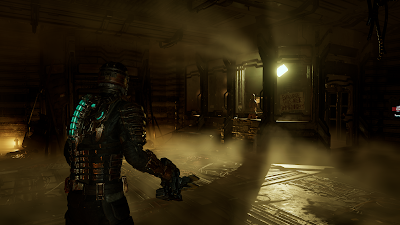
For the most part, DSR makes incremental improvements on the original game's mechanics and gameplay, sticking mostly to what that first game built, while making a few welcome improvements here and there, but there is one area of DSR's gameplay that is genuinely remarkable, and that's the all new, interconnected and fully explorable USG Ishimura. In the original game, the Ishimura was split into different decks, there was the Bridge, the Medical deck, the Engineering deck and so on, with each deck being the setting of a chapter in the game. At the start of a chapter, you'd get off the tram, explore the deck, then get back on the tram at the end of the chapter, at which point you'd be unable to return to that deck. In DSR however, all the decks of the Ishimura have been stitched together into a seamless open world where, as you progress the story and unlock new areas, previously unlocked areas remain fully explorable. As you progress through the story, your security clearance level increases, opening up new doors in previously explored areas to encourage backtracking. DSR gives the Ishimura the full RPD treatment, and like RE2's RPD, anyone at all familiar with the original game's environments will immediately get a strong sense of deja vu. Many of the areas from the original Dead Space have been brought over almost exactly, tweaked slightly so that they fit into this new interconnected ship. That DSR can make such a monumental technical leap on the original game, while keeping the original game's environments more or less unaltered is absolutely mind blowing to me, and the fact that it looks and runs as flawlessly as it does, having being rebuilt from scratch in the Frostbite engine, makes me wonder if anyone on the dev team sold their souls during development.

DSR doesn't stop being better than the original with it's interconnected world either, it also makes plenty of quality of life improvements and reworks certain sequences of the game so that they don't suck. I refer, of course, to the original Dead Space's terrible ADS sections, where you have to sit in a chair and protect the Ishimura's hull from incoming asteroids with a stationary cannon, and later on, when you have to shake off a big flesh slug on the ship's hull, all while it's throwing explosives at you. These sections in the original game were always frustrating to play through, something you had to get over with before you could get back to enjoying the game, but in DSR, these sections have been completely redesigned. Now, Isaac space walks and controls the ADS cannons with his Kinesis module, syncing aiming them to his weapon aim. This is not only a monumental improvement on the original's ADS sections, it's actually kind of fun now, as you have to defend yourself from regular enemies while also keeping an eye out for incoming asteroids, stopping them before they hit the Ishimura. And yes, I did just say Isaac can space walk, because DSR also brings in Dead Space 2's zero-gravity movement, replacing the original game's hopping around with magnetic boots in favour of full, three-hundred and sixty degree movement in zero-gravity, which is no less disorientating, but a lot less finicky, and would almost be relaxing, if it weren't for the Necromorphs comically throwing themselves around these areas after you. Many of the game's zero-gravity sections have been tweaked to better suit this new movement system, like the now much improved Leviathan fight, but like with many of the game's environments and combat sequences, the tweaks are so subtle you might not even notice them which, given how radically different the zero-gravity movement is, is amazing.

DSR also introduces a completely new element to it's gameplay in the form of Circuit Breakers. At several points in the game, you'll have to use these Breakers to power things, but to power them, you'll need to power off some other system. The game's introduction of the Circuit Breaker mechanic is brilliant, as you need to power a door to progress, but the Breaker and the door are on different floors and the lift also needs power, leaving you with only one option, turning off the lights. This is one aspect of DSR that feels a bit undercooked, however, as outside of a few really cool and slightly sadistic choices you have to make, there aren't all that many memorable moments with the Circuit Breakers. I feel that these could have been used more to make the player make difficult decisions, as well as to encourage experimentation, like at one point where you have to choose between turning off the lights and turning off the air, more of that would have been awesome. DSR makes more huge leaps from the original in it's graphics, as DSR looks amazing, everything from textures, to models, to lighting and particle effects has been completely overhauled, and while the smoke and lighting effects can look a bit wonky in some places, for the most part, I'd comfortably say this is the most graphically impressive game I've ever played, seriously, the game looks that good. But what's even more remarkable about how the game looks is that even though it was build from the ground up in a new engine, none of the style and visual language of the original Dead Space was lost in translation. All of the visual elements of Dead Space are still here, the look of the technology, the haunted house atmosphere and grimy industrialism of the Ishimura, the knack for visual storytelling, everything's here, just now with shiny, next-gen graphics.

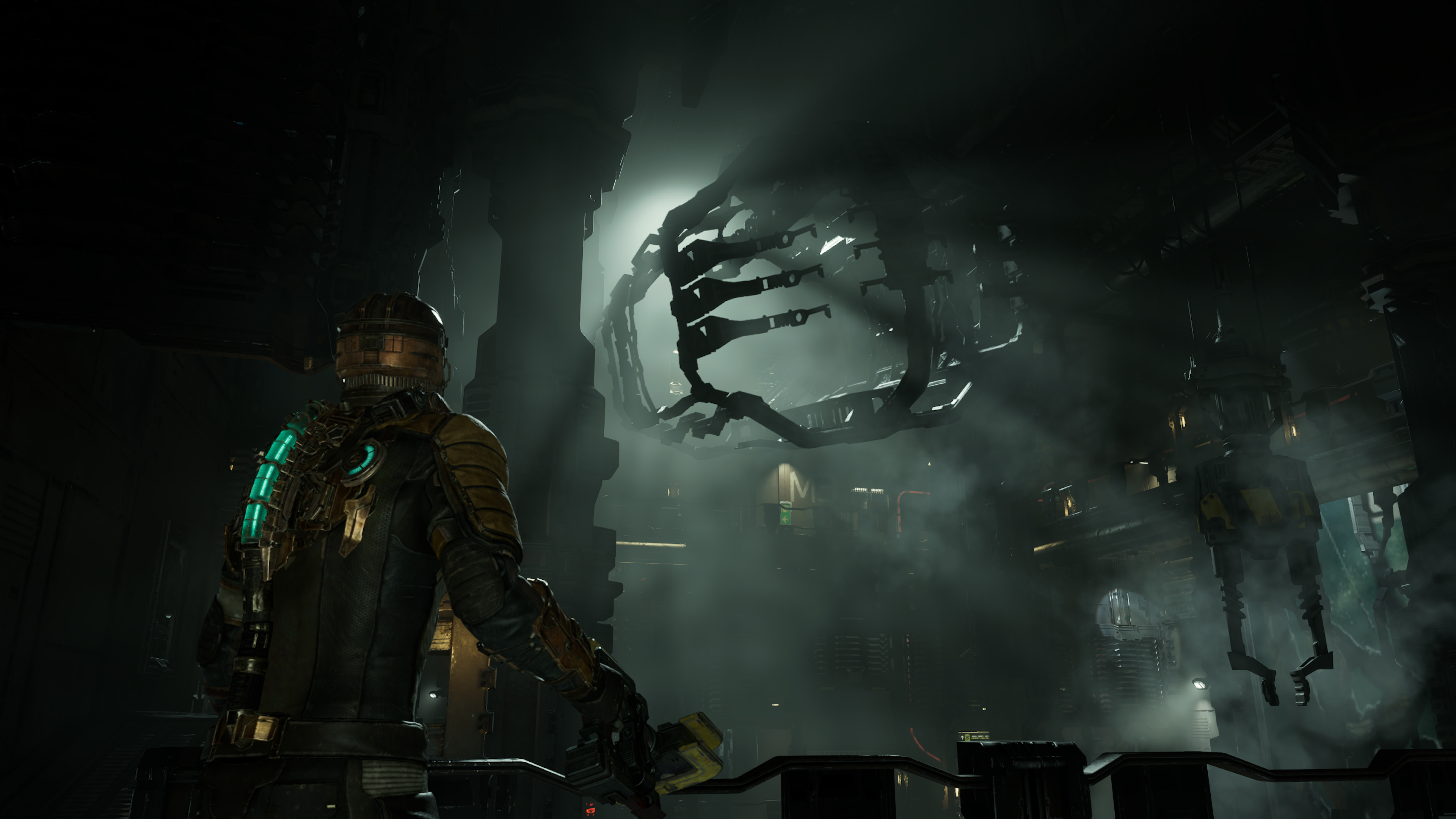
This is not a unique observation when it comes to DSR, but it looks like how I always remembered the original Dead Space looking, it's just Dead Space, but the best looking version of it. In addition to fooling around with enemy placement, the director system also likes to play with atmospheric elements like smoke and lights, making exploring the Ishimura even more unpredictable, and sometimes a lot more tense as well, as you might have to navigate with only the light from your flashlight. But outside of the new engine and all it's shiny trimmings, this is still Dead Space; everything that made that original game's world and atmosphere so fantastic is all still here. The Ishimura is not a clean, futuristic spaceship, it's a dirty, well-worn, industrial old boat that still manages to feel old and out of it's time, despite being from the twenty-fifth century. The Ishimura's endless passageways are dark and grimy, it's architecture completely abandoning any sense of form, it's not comfy or pretty, it's sharp, cold and metallic, the lights flicker on and off, and many areas of the ship are enveloped in darkness. In amongst the hard and unforgiving edges of this sci-fi setting are eerily organic design elements that make the Ishimura feel simultaneously alive and long dead. Isaac's Rig is covered in metallic ribs and bands of armour plating, a visual motif that extends to the entire ship; the hull of the ship has massive rib like structures on it's port and starboard sides, like the ribcage of some massive creature that's long since rotted away to nothing but bones. As the Corruption spreads more and more throughout the ship, it creates a sense that this very dead ship is coming back to life, not the life and majesty it might have once had, but a new, corrupted form of life, an undeath growing like a cancer through the remains of the ship.

As you explore the decks of the Ishimura, you start to see more indications of what life aboard the ship was like, from the luxurious cabins of the ship's officers, all the way down to the cramped and demeaning crew barracks, with bunks literally stacked on top of each other, advertisements for in universe products and services plaster the walls of the ship, as well as vending machines and shops. You can find a gym and sports hall where you can play zero-gravity basketball on the crew deck, and as you explore Hydroponics, you can find fruits and vegetables growing in climate controlled greenhouses. The various decks of the ship all have clear and understandable functions; like the Medical deck essentially being the ship's hospital, Hydroponics producing oxygen to breathe, but also growing food, and Mining and Engineering handling mineral extraction and ship maintenance, respectively. Thanks to DSR's new open world design, they now make even more sense, having been stitched together into a seamless, single world that the player can explore at their leisure, making this already very well realised and believable world even more believable. This commitment to believability extends to gameplay as well, which is another area that Dead Space really stands out in. Unlike other third person shooters, Dead Space has no heads-up display, no onscreen ammo or health counter in a corner of the screen, instead, that information is presented to you in the world itself; the spine of Isaac's Rig tells you how much health you have, right next to the Stasis dial that tells you how much charge you have.

When you aim a weapon, that weapon's ammo counter is displayed on the weapon itself, and instead of crosshairs for aiming, the weapon you're using projects targeting lasers. When you open your map or inventory, or when you open a video or text log, the information is projected in front of Isaac by his Rig in real time, and it's the same with shops and benches, while you're in a menu, the world around you is still turning. Like with the in universe health bar and the enemy dismemberment, this might seem like a gimmick on the surface, but that notion will evaporate the moment a Necromorph attacks you at the Shop, or opening your inventory to use a medkit during a fight leaves you completely open to a finishing blow. With DSR's open world and intensity director occasionally being sadistic with enemy spawning, opening an in game menu forces you to drop your guard and put yourself at risk of getting jumped. All of these basic gameplay elements are presented to the player within the game's world, yet not once does this feel like a gimmick, like every other aspect of the game's world building, its clearly something that the developers of the original Dead Space put a lot of thought and effort into, and DSR's developers clearly understood the importance of this key part of the original game's character. DSR's worldbuilding and gameplay is every bit a strong as the original game's, and there are clear areas where DSR makes huge improvements which it deserves credit for. A fully explorable and backtrackable Ishimura, a completely reworked gore system, and the classic Dead Space's in game menus and lack of a hud all come together to make what I'd confidently call the best game in the series, in terms of gameplay at least, like the new graphics, it's just Dead Space, but the best possible version of it.

I'd love to say that the game's story is every bit as big an achievement as it's gameplay, but while I'd still say it mostly is, there are issues here and there that drag it down. DSR's story follows the original game's pretty much to the letter; Isaac and the Kellion crew get stranded on the Ishimura and have to fight for survival, repair the ship and find a means of escape, all while slowly getting sucked deeper into an unravelling corporate conspiracy and the influence of the Marker. Over the story, Isaac meets a few new friends and enemies, loses a couple of close allies and by the end, is revealed to have completely lost his mind, all the beats of the original story are here, but DSR makes one massive change which is undeniably for the better. In the original game, Isaac Clarke was a silent protagonist, something that was changed in Dead Space 2 where he's voiced by Gunner Wright. Wright returns for DSR, and Isaac Clarke is now fully voiced, and anyone who was worried about this change had absolutely no reason to be. Having Isaac talk now has a few huge benefits; chiefly how key bits of information are delivered and how much more personal the game's story is. Since Isaac didn't talk in the original, the game's more reliant on Kendra and Hammond to deliver information, but in DSR, Isaac's expertise as an engineer can really shine, as rather than following orders from Hammond and Kendra, he's now solving problems himself. This makes several of the game's engineering sections feel a lot more organic, as for example, rather than Hammond telling Isaac to get the hydrazine tank and the shock pad to blow up the barricade in Medical, Isaac comes up with that plan on the fly.

This not only makes more sense for his character, but makes the task of blowing up the barricade feel a lot less like a video game fetch quest and more like a problem that we solve organically. This shift in how information is given to the player carries throughout the entire game, making Isaac feel like a vital part of this story, instead of just a video game character doing video game things within the story. As Isaac Clarke is now fully voiced, it also opens up a whole new way of tackling Dead Space's story, one that puts Isaac centre stage and tells a personal story about him dealing with his grief while losing his mind, which DSR absolutely goes all in on. The result is mostly great, with it feeling almost like the original game's story was rewritten to retroactively tie into Dead Space 2, as well as letting us get to know Isaac Clarke a lot better before we catch back up with him in that sequel. DSR brings in a few story details from Dead Space 2, including lines of dialogue that flesh out Isaac's and Nicole's relationship, something that was always absent in the original game. Though it's with Nicole that things get a bit rocky, and where I'll need to spoil the big twist ending of a sixteen year old game. For those who somehow don't know Dead Space's twist ending, here we go, it turns out that Isaac's girlfriend, Nicole, who he went to the Ishimura to find in the first place, has been dead the entire time, and his interactions with her throughout the game were hallucinations beamed into his head by the Marker. DSR goes the extra mile in setting up this twist; showing Kyne, Kendra and Hammond all having hallucinations of dead people, bringing in the beat from Dead Space 2 of Isaac pressuring Nicole to become part of the Ishimura's crew, and showing the last conversation the pair ever got to have, which was an argument that left Isaac, who'd just lost both of his parents, feeling that he'd lost everything.

DSR's characterisation of Isaac and recontextualising of his guilt in Dead Space 2 is brilliant, making so much of his inner conflict in the first two games make so much more sense, and really making you feel for the guy. Isaac Clarke knew that Nicole was dead before arriving at Aegis VII, but perhaps out of denial or a need for closure, exposed himself to the Marker, which shows people things, things that, deep down, they may want to see, which is dark as shit, whatever way you look at it. Where things get a bit wonky is how Nicole acts when we meet her, because she acts really weird, not sounding or acting anything like the Nicole we see and hear in the game's audio logs and flashbacks. It's as though the game assumes that you know the twist and is playing into it, but I think knowing the twist makes this worse; it's even more obvious that something is really wrong with Nicole, and it's odd to me that the game can foreshadow the twist so well in other areas of it's story, only to go too far in telegraphing it when we finally meet Nicole. That being said, seeing Isaac being relieved to finally see Nicole again, seemingly unaware of how strange she's behaving, could be read as another layer of his tragedy, a state of denial worsened by his collapsing sanity and the influence of the Marker. Isaac is so desperate for things to be ok, that he'll happily embrace a fantasy being beamed into his head, by an evil force that's using him for it's own ends. This does leave me conflicted though, as while I can see what the game might have been going for, I still feel like it makes the twist a little too obvious for it's own good.

DSR also has a little surprise of it's own in it's finale, one that's clearly trying to catch Dead Space veterans off guard and to fix a plot hole in the original game. But all this mini twist does is open up more questions, while also stretching suspension of disbelief a bit too much for my liking. Of course, I'm talking about the reveal that the Nicole we've been seeing is actually Elizabeth Cross, the scientist from Hydroponics who helps Isaac kill the Leviathan, and that she's been hallucinating that Isaac Clarke is Jacob Temple, her boyfriend who gets his head blown open with a bolt gun a few chapters earlier. Again though, this could be looked at another way that makes more sense, that being that the Marker is so powerful and so insidious that it can completely destroy one's sense of free will, manipulating them into doing its bidding by showing them what they want to see, but to have two people on two completely separate quests, unknowingly meet up and have everything they do work perfectly in the Marker's favour, it feels a bit too convenient for me. Other changes fair better than this one, of course, though other changes are also contentious. One change is how Hammond dies; in the original game, after the USM Valor crashes into the Ishimura, Hammond and Isaac board it to steal it's Singularity core. Isaac successfully gets the core and makes it off the Valor before it explodes, but Hammond is cornered by a Necromorph Brute, going down fighting before getting crushed. In DSR, Isaac and Hammond still board the Valor to steal it's Singularity core, and only Isaac gets off the ship alive, but rather than being killed by a Brute, Hammond, who is shown to have completely lost his mind, is fatally wounded by the reanimated corpse of his friend, Chen, who died in the flight lounge right at the start of the game, and has been tailing him ever since.

In his final moments, Hammond snaps back to reality and, finally accepting that Chen is dead, pushes the Slasher that used to be Chen into the Singularity core, killing them both instantly. On paper, this is a brilliant change, one that gives Hammond a tragic end that mirrors Isaac's own journey into madness, as well as showing just how powerful the Marker is, that it can even break someone as strong as Hammond. The problem is that we don't know anything about Chen, like in the original, he's just the first guy to die, we have no time to form any kind of attachment to him, meaning his death carries little weight. I understand the intention here, DSR is trying to give his death more weight by having his reanimated corpse shadowing Hammond, which also deepens Hammond's story and gives his death more weight in turn, I just wish I could say that it stuck the landing in execution. Kendra hasn't really changed at all, still being the team's computer expert who gets revealed at the eleventh hour to be an EarthGov agent. But like Hammond, DSR puts a tiny bit more meat on her bones, by having her also suffer from hallucinations as the Marker gets into her head. Dr Kyne returns from the original, though something was very much lost in translation with him, as it's almost remarkable how boring they made him, while Temple and Cross are both given a lot more to do in DSR, but there is one character from the original game that DSR really steps up, and that's Dr Challus Mercer. In the original game, Mercer is a Unitologist zealot who worships the Necromorphs and creates the Hunter, an indestructible Necromorph that hunts Isaac at several points throughout the campaign. None of that's changed in DSR, but what has changed is just how cruel and sinister Mercer is.

This Mercer is a villain, straight up; he doesn't just worship the Marker and the monsters it creates, he experiments on fellow survivors to create more monsters. He is obsessed with Convergence, believing that the Marker can bring it, granting him and his fellow believers eternal life, and is ruthlessly determined to bring about that Convergence, either killing people who get in his way, or sicking his Hunter on them. He honestly believes that the Necromorphs are divine, the next step for humanity on it's holy journey to being made whole. He's no longer just a mad scientist that occasionally shows up, now he's a genuine antagonistic force that is doing everything he can to aid the Marker, one who, instead of a pathetic suicide by Infector, is given the poetic send off of having all his devotion to the Marker cast aside when it apathetically denies him his Convergence. Mercer always felt small in the original Dead Space, just another lunatic on a ship full of them, but now, Mercer really feels like the villain he always could have been, and I love it. But all this about Convergence and the Marker, what does any of it even mean. I've talked about the lore of Dead Space a fair bit in my reviews of the first two games, but since I love to ramble away on things I love, I'm going to do it again. Dead Space's lore was always one of the best things about the original trilogy of games, even when said trilogy stumbled over the finish line in Dead Space 3, and DSR takes all of the best parts of the original trilogy's lore and flawlessly stitches it all together, giving us just enough to get us hooked, while clearly leaving room to grow in sequels that this game deserves, but will likely never get.
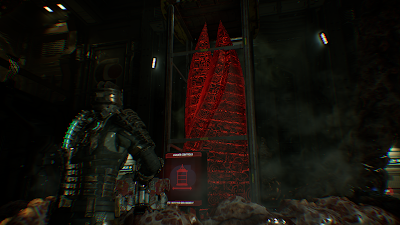
First off, the Marker, an alien artefact dug up by the Aegis VII miners, that drives people insane and reanimates the dead. The Marker was always one of the most terrifying things in the first two games, a glowing lump of evil that uses your own mind and flesh against you, and like many other parts of the original Dead Space, the terror of the Marker was not lost in translation. Even though the Marker itself doesn't appear until near the game's finale, it's presence is felt throughout the game; strange symbols are scribbled all over the walls of the ship, some depicting a double helix type structure, others are messages, written in the same alien language that covers the Marker's surface. But the Marker is no simple cursed object, it has a will of it's own and a mechanism of acting on that will that's as fascinating as it is terrifying. The Marker makes people go insane, it causes insomnia, paranoia, hallucinations and dementia, attacking the minds of the people it influences, using the people who can understand it's signal as pawns in it's plan, and destroying the minds of people who can't. The Marker is capable of altering your perception of reality, making you see whatever it wants you to see, and using your darkest secrets to break you down. As the madness worsens, it's only a matter of time before people start dying, which is where the Marker really starts to flex it's power. The Marker is able to reanimate dead flesh, recombining and reshaping the dead into it's own army of monsters, all completely lacking intelligence, individuality, mercy or fear, they are puppets who's only purpose in unlife is to gather biomass for the Marker's true purpose; Convergence.
.png)
Convergence is something DSR doesn't explain, though it has been explored in Dead Space 2 and 3, and for the Unitologists who worship the Marker, it's a divine event that will unite those who believe in body and mind, allowing them to live forever and become whole. In reality, it's what happens when the Marker has enough biomass to create a Brethren Moon, a superorganism made up of the flesh the Necromorphs have been able to gather, an immortal creature that wanders the stars, seeding worlds with Markers to trigger the evolution of intelligent life whose minds those Markers can infect. This makes the detail that the Aegis VII Marker is actually a copy of a Marker that was found on Earth all the more terrifying, as it means that Earth was seeded by the original Marker, and that the evolution of humanity wasn't natural, but was accelerated over millions of years by the Marker. This recontextualises the entirety of human history in a truly terrifying way, implying that for all the human race has achieved, for all that makes us unique and special, all the value we give our lives, we are nothing, all we ever were was food, part of the life cycle of a superorganism that has quietly dominated the entire galaxy for potentially billions of years. The Brethren Moons are a form of life unlike anything we can imagine, there is nothing in the human experience that can even slightly compare to the age, intelligence and hunger of these impossible creatures, they are hungry, they are coming, and there is nothing anyone can do about that. The depths of the Dead Space universe, and all the cosmic horrors within, is one of the main reasons I keep coming back to this franchise. It takes a simple premise of zombies in space and twists it into a Lovecraftian nightmare, one that solves the Fermi Paradox in one of the darkest and most nihilistic ways any piece of fiction ever has. For me, this makes Dead Space the complete package; it has really enjoyable gameplay, great storytelling and worldbuilding, a strong story of overcoming your inner demons and letting go of your grief, fantastic and terrifying monsters, and a lore that my autism riddled brain can get lost in for hours, and with all the tweaks DSR makes to build upon what the first game had and tie it back into the second and third games, it makes this remake feel even more complete, in spite of it's occasional missteps.
Make Us Whole Again
Very few games have come out in the past half decade or so that have got me really excited, that I just got completely obsessed with, that I came to really love, but DSR is one of those games. It has everything I loved about the original Dead Space, trims and reworks what little I didn't love, and reworks the game's story in a way that flawlessly ties it into Dead Space 2, and though a remake of Dead Space 2 is unlikely to ever happen, if it did what DSR does even half as well as DSR does it, it would surely join DSR as one of the best video games of this generation. DSR is a fantastic game on just about all fronts; it's spooky, violent, disturbing, visually stunning, fun to play, stacked with opportunities to explore and experiment, tells a fantastic story, and reintroduces us to one of the most fascinating and existentially frightening universes in all of video games. If you haven't worked it out yet, I absolutely love this remake, I adore exploring the bowels of this ghost ship and ripping and tearing through it's reanimated crew, but I love it's exploration of Isaac Clark's mind every bit as much. It doesn't get everything right, there are aspects of it's story that feel undercooked, as well as a few of it's twists and turns not sticking the landing as well as they probably needed to, but what it does get right is more than enough for me to call this game an absolute must play.

.png)




.png)


